


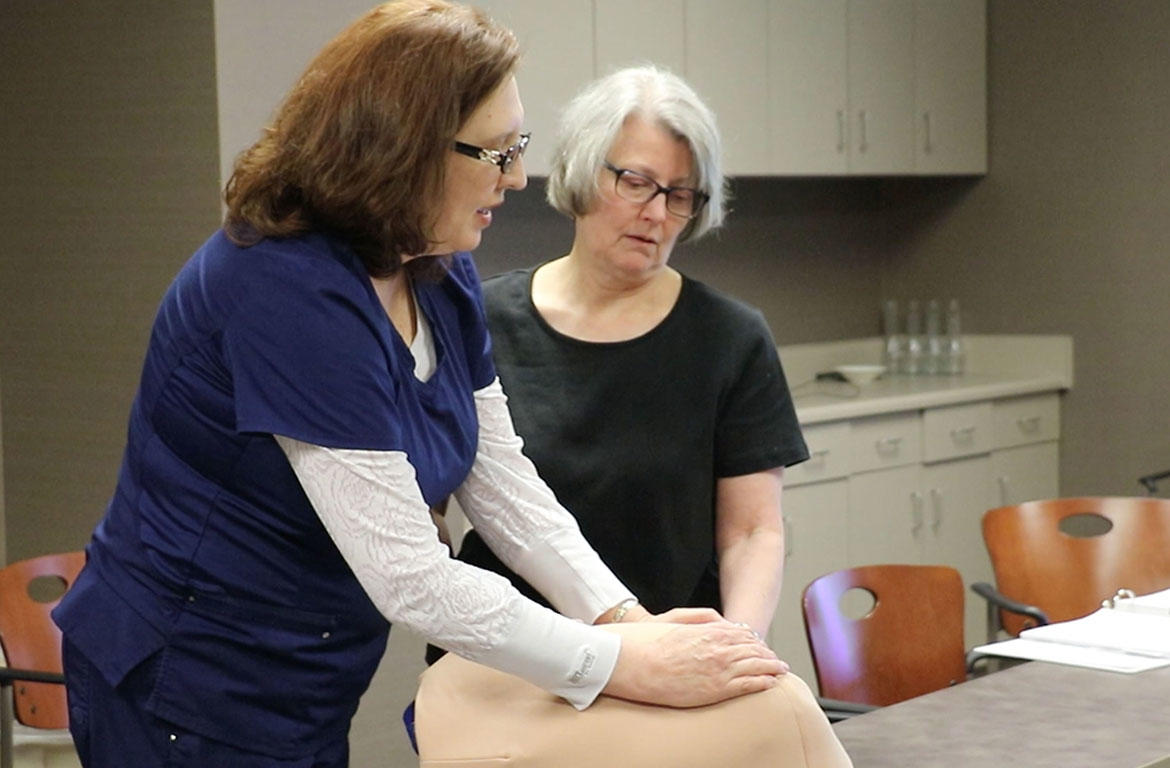

FORT CAMPBELL, Ky.- (CLARKSVILLENOW) A nurse from Blanchfield Army Community Hospital(BACH) recently joined nurse educators at a local hospital to conduct training on fetal heart monitoring to increase its capabilities.
Certified nurse midwife Carol Lindsey, has more than thirty years of experience helping bring babies into the world and has an advanced qualification in a fetal monitoring technique that allows her to train other nurse educators. Clarksville Tennova Healthcare wanted to expand its fetal monitoring training program and Lindsey shared her expertise.
Fetal heart monitoring during labor allows the medical team to monitor how the unborn child is handling labor.
“Labor is a stressful process for both the mother and the unborn child. They are both going through a major physical event. We can ask the mother how she’s feeling. We can use her vital signs to know how she’s doing, but the only way we truly have to stay in touch with the fetus is by heart rate pattern,” said Lindsey.
An abnormal fetal heart rate during labor lets medical staff know that action is required to get more oxygen to the fetus. Sometimes it may be as simple as having the mother move her position to relieve pressure on the fetus, but other times it may indicate something much more serious requiring emergency intervention through a cesarean section, forceps or vacuum-assisted delivery.
“Over years of experience we’ve developed some ideas of what the heart rate pattern tells us about the fetal oxygenation status. We know that it’s important to have oxygen and we know that labor in itself can change that oxygen availability to the fetus. So by watching the heart rate pattern, we make changes for the mother so that the oxygen passes through her body more easily for the fetus or we may make changes in her management plan and delivery plan if it’s apparent that the fetus is not tolerating the stresses of labor,” Lindsey said.
Labor and delivery nurses study fetal heart monitoring during their advanced schooling and must earn a fetal heart monitoring certification to work in labor and delivery. Additionally, they must recertify on the skill every two years to maintain their certification, which could require lost manpower and costly travel to attend an off-site course. Having a certified training program within a hospital helps to keep nursing staff qualified with less disruption to patient care.
Lindsey’s role at Tennova was training the instructors and helping them understand the course content and administrative portions of the course.
“We’re very excited about this nurse program at Tennova because helping to deliver babies is the best job in the world,” said course participant Trish Sutton, a perinatal nurse educator for Tennova Hospital who was qualifying to teach fetal monitoring at Tennova.
BACH leadership supports networking with TRICARE partners, relying on their capability and expertise to help provide quality care to beneficiaries in the Fort Campbell community.
“Building partnerships within our network is critical,” said Col. Anthony McQueen, Blanchfield Army Community Hospital commander. “When we have maximized our capacity, or do not offer a service, these partnerships give us confidence that our beneficiaries will be receiving quality care provided by the partnering facility.”