


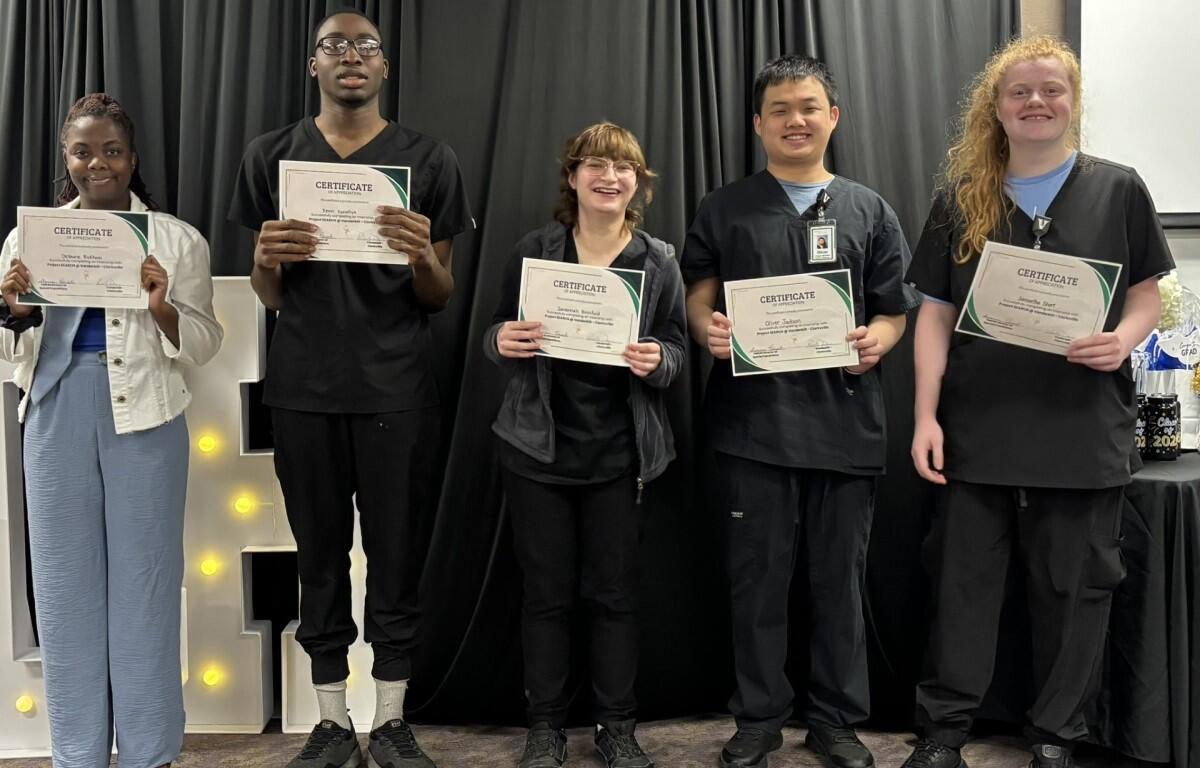

CLARKSVILLE, TN – Five students completed the 2025-2026 Project SEARCH Transition-to-Work Program this spring at Vanderbilt Clarksville Hospital, joining a growing roster of graduates who have built real workplace skills — and in many cases, launched careers — through the yearlong program.
This year’s graduates are Oliver Jackson, Savannah Birchfield, Kevin Kpelafiya, DaVaune Bickham and Samantha (Sammie) Short.
Project SEARCH places high school seniors with disabilities directly in the workplace for a full year, combining classroom instruction, career exploration and rotating internships across hospital departments. The program serves students ages 18-22 who are not on track to earn a general education diploma.
The Clarksville-Montgomery County School System (CMCSS) Project SEARCH program has operated in Montgomery County since 2012, when it became the first official Project SEARCH model site in Tennessee. Since 2017, Vanderbilt Clarksville Hospital has hosted the program, taking on all available intern spots. What began with a single participating department has grown steadily as hospital leaders recognized both the value interns bring to their teams and the quality of the experience for students. Seven departments, including Cardiac Services, Labor and Delivery, and Radiology, hosted interns in the 2025-2026 school year; that number is set to expand to 10 in the upcoming year.
Tennessee now has more than 18 Project SEARCH sites, including Monroe Carell Jr. Children’s Hospital at Vanderbilt. The state ranks among the top three in the country for employing individuals with disabilities through the Project SEARCH model.
Finding ability in every task
When Kevin Kpelafiya joined the program in fall 2025, he expected to spend most of his time in nutrition or housekeeping. Then his rotations took him somewhere unexpected: the Facilities and Maintenance team, where he helped replace ceiling tiles, paint, patch walls and support hospital systems operations.
John Wilson, Director of Facilities, said Kpelafiya’s impact on the team was immediate. “Kevin was an inspiration from the day he walked in,” Wilson said. “It was a joy to see him interact with the team and to witness his excitement about the work each day. He embraced learning new skills and approached every task with enthusiasm. Through it all, we didn’t focus on his disability; we saw his ability and the value he brought.”
Growing confidence, one rotation at a time
Sammie Short came into the program quietly. Coordinators were initially concerned her shyness might hold her back, but it didn’t.
With consistent mentorship across her department rotations, Short’s confidence and independence grew in ways her family noticed at home as well as at work. “She truly enjoyed being part of the workforce through Project SEARCH, learning new skills each day and helping others,” her mother said. “Every department made her feel welcome, valued and like an important part of the team.”
Beyond job skills, Project SEARCH builds the foundational competencies that make employment sustainable: time management, communication, self-advocacy and teamwork.
Since the CMCSS program launched in 2012, it has served 45 students. Twenty-one have achieved successful employment outcomes — defined by the Project SEARCH model as inclusive community employment of at least 16 hours per week, at a standard or better wage, sustained for at least 91 days.