


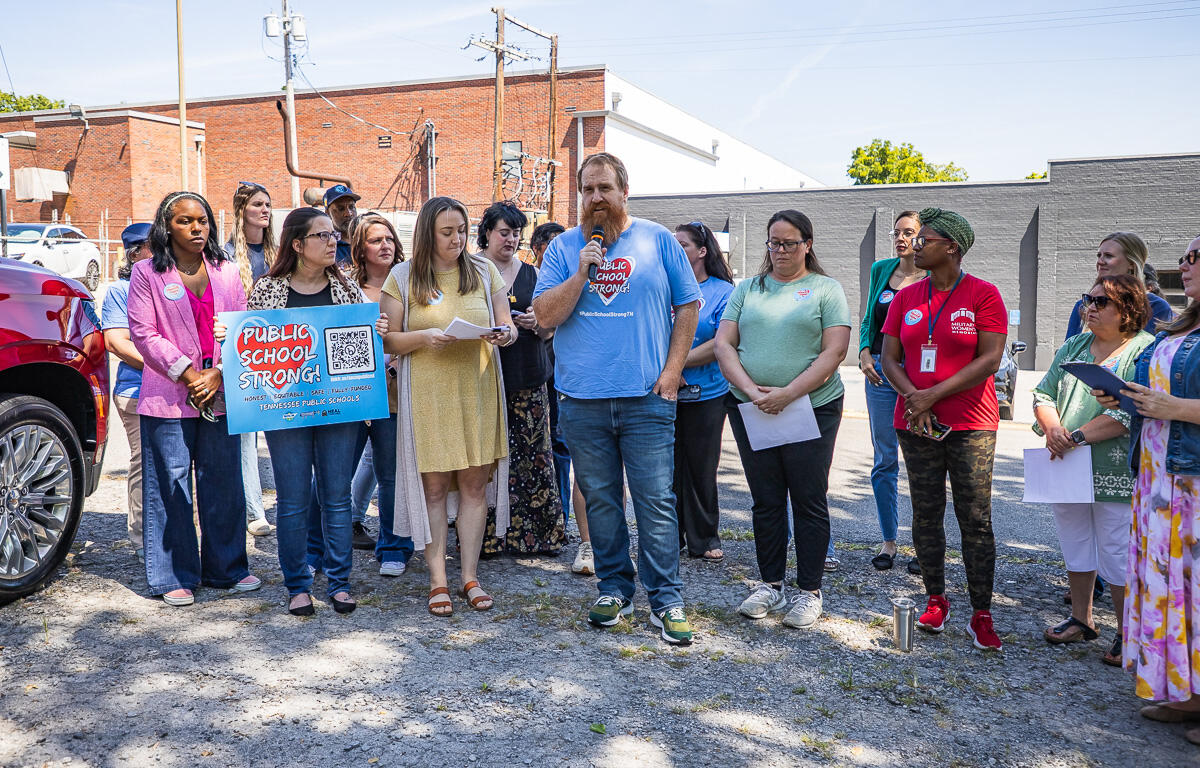

CLARKSVILLE, TN (CLARKSVILLE NOW) – Parents and outside service providers gathered this week across from the Clarksville-Montgomery County Schools Central Office to raise concerns about new requirements they say are making it harder for some students with disabilities to receive medical and behavioral support during the school day.
The concerns involve outside medical providers who work with students in CMCSS schools, including behavioral professionals and private nurses. The issue comes as Tennessee begins implementing a new law, Public Chapter 1112, that requires public schools to allow certain private providers to help eligible students during the school day. Gov. Bill Lee signed the law on May 22, and it applies beginning with the 2026-27 school year.


Providers and parents said they received updated CMCSS requirements on Aug. 3 that created additional hurdles for providers trying to work with students in schools.
One of the main concerns raised Monday involved insurance requirements. The group said that after insurance approves the treatment, school representatives can still determine how much of that service can take place during the school day. The group said those changes have delayed or prevented some students from receiving services they previously received at school.
What is ABA, or applied behavior analysis, therapy?
One of the main services discussed Monday was “applied behavior analysis.” ABA is a type of therapy that uses observation and data to help people develop skills and manage behaviors. For students with autism or other developmental disabilities, ABA can help with communication, managing emotions, following directions, interacting with others and safely participating in school.
A BCBA, or board-certified behavior analyst, is a professional who develops and oversees ABA treatment. An RBT, or registered behavior technician, provides ABA services under the supervision of a BCBA.
The providers who spoke Monday said their services are paid for through TennCare, private insurance, TRICARE or other outside sources rather than by CMCSS.
What are providers, families objecting to?
Materials distributed at the event said outside service providers are being asked to carry sexual abuse and molestation coverage. Carissa Coker, a board-certified behavior analyst and owner of Clarksville Autism Center, said the insurance requirement has been one of the biggest obstacles for local providers due to the high cost. The providers are asking for the requirement to be reduced to $1 million per occurrence and $1 million in the aggregate.
Providers also raised concerns about a new collaboration process that takes place before services begin. Rachel Olive, a BCBA who said she has practiced in Tennessee for seven years, said ABA providers first evaluate a child and develop a treatment plan based on the child’s needs. That plan is then submitted to an insurance company for review.
Olive said that after insurance approves the treatment, school representatives can still determine how much of that service can take place during the school day. She said school officials have important knowledge about education and how schools operate, but medical providers should remain responsible for clinical decisions about a child’s treatment. “Collaboration and clinical decision making are not the same thing,” Olive said.
The providers said they are not asking to work independently from school staff. Instead, they said they want to work alongside teachers and administrators while providing the treatment their patients have been approved to receive.
CMCSS: Updates taking time to implement
CMCSS said its updated requirements were made to align with changes in state law and guidance from the Tennessee Department of Education. “For many years, CMCSS was one of the only districts in the state to allow Outside Service Providers access to students during the school day for the purpose of providing privately paid services,” according to a statement from CMCSS spokesman Anthony Johnson.
CMCSS said it revised its Outside Service Provider Agency Policy and related procedures this summer. “These updates included adding necessary insurance requirements, proof of certification/licensure by the provider, a required Memorandum of Understanding, and stronger confidentiality and liability waivers for the outside service providers who are working in classrooms around all students in those classrooms, not just the students receiving the services from the outside providers,” Johnson said.
The district said its insurance requirements are within customary limits and are consistent with requirements used by other Tennessee school districts. Johnson also said the new state law requires school districts to allow access to private-pay ABA clinics, but that the district continues to allow other outside providers, including private-duty nurses and mental health providers, to work with students.
“Several Outside Service Provider agencies have already obtained and submitted proof of required insurance coverage, and CMCSS expects additional agencies to be approved in the coming days,” the district said.
CMCSS attributed delays in the updated process to the timing of state guidance and a technical error that prevented some communications from being sent as early as expected. “We have reallocated personnel to handle the high volume of requests,” CMCSS said. “CMCSS appreciates everyone’s patience as we all work through these new requirements.”
Parents say students losing access to support
Several parents spoke Monday about how the changes have affected their children. Danielle Burwell, whose 5-year-old son James has autism, said ABA therapy has helped him learn to manage his emotions and impulses.
James recently started kindergarten, and Burwell said she is concerned he may not be able to receive the same support at school that has helped him in other settings. “I am not asking the school system to provide this service,” Burwell said. “I am asking the school system not to stand in the way of qualified professionals who are already prepared to provide it.”
Burwell said ABA has also helped her family by giving them strategies and guidance for supporting James at home. Ritchie Patton, a parent of several children who have attended CMCSS schools, said his family made the decision to remove his nonverbal son from CMCSS schools this year.
Other parents described concerns about students losing access to services and how behavioral challenges can affect a student’s ability to remain in class.
| GET YOUR LOCAL MORNING NEWS: Sign up for our free daily email newsletter.