


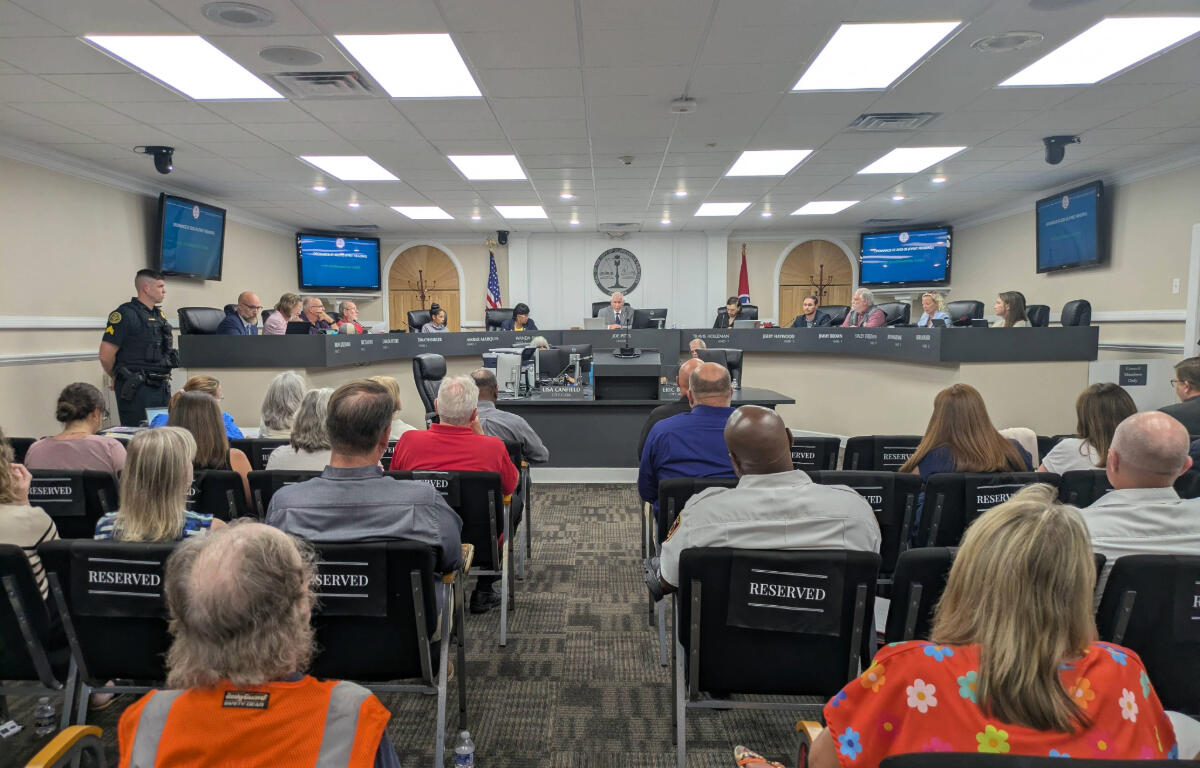

CLARKSVILLE, TN (CLARKSVILLE NOW) – This month the City Council is considering withdrawing from a local option sales tax agreement with Montgomery County, phasing it in over the course of several fiscal years, which would begin in 2027.
This comes after Councilman Brian Zacharias said the City of Clarksville is at the edge of a “financial cliff” based on projections he shared last month, which prompted him to sponsor the resolution.
“The City Council finds that adjusting the city’s share of the non-school portion of local option sales tax proceeds, phased over several fiscal years and developed jointly with the county, is a fiscally responsible alternative to closing the gap solely through an increase in the city property tax rate,” said the resolution. “And the county will need time and joint planning to adjust its own budget.
“The City Council desires that the city and the county work together, through a joint
committee, to settle the details of the transition and to memorialize them in an interlocal
agreement under the Interlocal Cooperation Act, Tennessee Code Annotated, Title 12, Chapter 9.”
| PREVIOUSLY: Growth isn’t paying for growth: Clarksville council to consider budget restructuring
Previously, when Clarksville Now reached out to County Mayor Wes Golden on the matter, he said his belief is that the financial move would shift 100% of the schools’ tax burden to county residents.
When the resolution was introduced to the Finance Committee earlier this week, Zacharias said one consequence of approving the proposal may be that the county would sue the city.
Addressing community concerns, legality of move
At Thursday’s executive session meeting, Zacharias addressed some concerns he’s heard, and he made the case for why the city may have legal standing to withdraw from the local option sales tax agreement with the county.
“First of all, this is not a bailout; I want to make sure everybody understands that. A 50-50 split between the school system and the municipality where the sales tax is collected is standard in the state of Tennessee.
“What we are doing right now is not typical,” Zacharias said while discussing the additional 20% in local option sales tax revenue allocated to the county annually, which in turn is allocated to CMCSS.
“We are not talking about removing a tax here. My understanding is that the tax itself was imposed through a referendum, but the split of the 25-26% that goes to the county, and the remaining 24% that stays with us, that is through an interlocal agreement between the city and the county.”
| GET YOUR LOCAL MORNING NEWS: Sign up for our free daily email newsletter.
While speaking on if the City of Clarksville could exit the agreement unilaterally, Zacharias said he discovered a recent ruling that may give the city legal authority to withdraw. “I learned of a case right here in Tennessee that happened two months ago,” he said. “Basically, Shelbyville was in a very similar situation with Bedford County that we are with Montgomery County right now.
“They asked nicely; the county refused, and Shelbyville actually sued Bedford County to get their sales tax back and (was) given authority to exit that agreement by a court. Bedford County appealed that decision, and it was upheld by an appeals court. So, there is precedent.”
Zacharias also said there is no risk to the school system with the resolution’s approval, later referencing state maintenance of effort rules, which protects local school funding. “I understand that the sales tax revenue that is currently going to the schools would have to be made up by the county, and that is the purpose of the working group: to let that transition happen as painlessly as possible.
“Which, incidentally, is the outcome that the court in Bedford County arrived at, where a court put the county and the city on notice with a deadline that they had to have the transition in place by,” he said. Zacharias said for this proposal, the deadline would begin next year.
Would this mean automatic tax increase for county?
Mayor Joe Pitts asked Zacharias several questions at the executive session meeting, including whether this means an automatic tax increase for county residents.
Zacharais said the council has no control over what the county does with their tax rate. “Without sitting down with the county, it would be difficult to say, but it does not mean automatic. This difference could be made up with reductions in spending or transferring some services that are provided by the county inside city limits. Maybe reduce some cost and overhead to the county. There are plenty of options out there, but none of them get considered if we’re not talking.”
| BREAKING NEWS PUSH ALERTS: Sign up for our free Clarksville Now app
While referencing a document that was given to each City Council member, Zacharias said it also appears that Montgomery County property tax funding to the schools has not really “kept up.”
“If the county was still supporting the schools at the same rate that they were 10 years ago, this would be a very different conversation,” he said.
Councilperson questions what was in referendum
Councilwoman Keri Lovato said she has a copy of the referendum that approved the original local option sales tax agreement between the city and county.
“In Section 6, it says that the county judge is hereby authorized and instructed to contract with the proper officials with the City of Clarksville to provide the division of half of the proceeds of the additional tax levied by this resolution not allocated to the schools as follows:
‘20% earmarked for instructional salaries in the county’s general-purpose school fund, the county’s statutory share to be allocated to the unified school system, and the remainder to go to the city’s general fund.‘
“To me, that reads like in 1977, the voters did in fact vote to give that money to the school system. Now, if we can unilaterally pull out of this agreement without going on referendum, maybe we can, but I think it’s inappropriate,” Lovato said.
What if Montgomery County sues city?
Councilwoman Stacey Streetman asked for clarification on whether Montgomery County could sue the city if the council approved the resolution.
City Attorney Eric Bittner said yes that is a possibly and referenced a previous lawsuit that was filed in 1996, which tied the local option sales tax revenue up for years in what he believes was an escrow account.
Bittner said the lawsuit resulted in a settlement between the City of Clarksville and the Montgomery County Government. “I would imagine the process of a lawsuit would take at least 18 months to two years,” he said.
Streetman said for the city or the county to sue the other, taxpayers would be the ones paying legal fees either way you look at it.
The conversation will continue at the City Council’s regular session meeting on Thursday, Nov. 5, at 6 p.m.
| ADD US ON GOOGLE NEWS: Click here to see more local news from Clarksville Now