



CLARKSVILLE, TN (CLARKSVILLE NOW) – Clarksville Fire Rescue is planning to decommission six rescue trucks as part of a revamped emergency response plan.
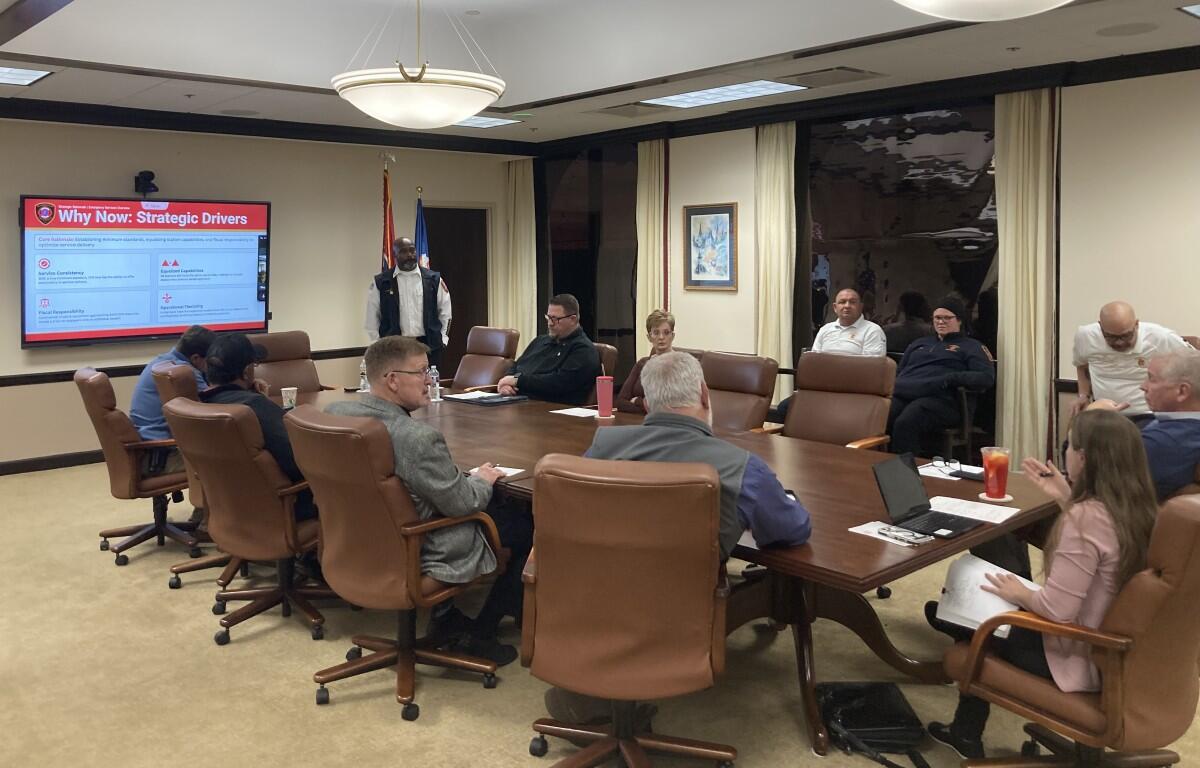
CFR Chief Freddie Montgomery Jr. presented the plan to the city Public Safety Committee on Thursday. The plan aims to eliminate issues they’ve experienced with manpower and redundancy. It’s the first update to the plan in nearly three decades.
Montgomery said the update is made possible because all city firefighters have now completed emergency medical responder certification. An emergency medical responder (EMR) is a trained professional who provides an initial response in a medical emergency. They help address urgent needs before more advanced medical providers take over.
“EMR is the new standard; dedicated rescue response is redundant when the closest apparatus possesses identical capabilities,” Montgomery told the committee. “So, what we’ve essentially done is with raising the standard to EMR. EMR’s are no longer just on those six rescue trucks. We are EMR’s departmentwide on all trucks.”
Current makeup of fleet, age of 6 rescue trucks
Currently, CFR’s fleet is made up of 23 vehicles: seven aerials, seven engines, six rescues, two tankers and one brush truck. There are five reserve vehicles: two aerials, two engines and one rescue truck.
Here’s when each of the six active rescue trucks were purchased:
- Rescue 1: March 10, 2022.
- Rescue 3: March 24, 2026.
- Rescue 6: Aug. 11, 2025.
- Rescue 9: Dec. 9, 2024.
- Rescue 10: May 10, 2023.
- Rescue 12: July 31, 2018.
Montgomery said with the eventual need for other replacement vehicles, which range from $1 million to $2.6 million, it no longer makes sense for him to go to the City Council every year and request a $500,000 rescue truck, especially with the department’s new capabilities in mind.
“Our model needs to be to where those big, heavy trucks, we need one in each district,” he said.
The six rescue trucks will not immediately be sold. Two will be repurposed for technical rescue operations, while the remaining four will be held in reserve as the department evaluates the transition, according to a Clarksville Now news partner WKRN.
Wanting to move toward ‘closest truck concept’
Montgomery said the emergency response plan is nothing new to the fire service industry, and it comes from an assessment conducted within CFR.
“I think anyone who knows me knows I’ve always pushed ensuring that every corner of the city gets the same level of service,” he said. “So, that’s what this is all about; that’s what the district concept’s about … these improvements are in the same line of moves I’ve requested for the last several years.
“We’re going to a ‘closest truck’ concept. We’ll be sending the closest available truck to any rescue type of call that comes in. And the big turning point is we now have a minimum standard; before this we did not have a minimum standard.”
Montgomery said with the existing plan, they’ve had 12 stations, also referred to as zones, and six of those stations have a rescue truck. “They run citywide, so what we’re experiencing is trucks being called out of zone,” he said.
He said with roughly 95 square miles to cover, and only six rescue trucks, waiting becomes an issue. “70-80% of our calls are emergency type calls, which would require that rescue,” he said. “That’s not only medical calls, but that’s (also) vehicle wrecks and things of that nature.”
Montgomery said the last rescue truck they purchased was about $450,000. “Of course, we know how those apparatus costs are going up, so you expect that to be more. And they carry about $250,000 worth of equipment.”
Expected to speed up response time
Montgomery said response time is expected to be sped up as well. “Our fire calls are in a zone or district, and we offer three- to five-minute response times citywide. The rescues are not that way,” he said. “The rescues are sometimes further off, and we have a longer response time to some of our rescue calls.
“The rescue model we have in place has become, over time, a catch-all for things we didn’t want to do as firemen. It was implemented initially as a stopgap measure 25-30 years ago to allow us to get on scene quicker and before EMS. EMS had extended response times, and they still do.”
Montgomery said with the current system, Clarksville is one of the few places where a fire truck shows up at the scene of a wreck, and they cannot extricate due to the lack of equipment – equipment that’s currently on the rescue trucks.
“A lot of times, these fire trucks go to these car wrecks, and they are waiting on a rescue truck to come and pop a door (open) to let somebody out. We are a better department than that, because we have raised our standards.” Under this change, the equipment will be moved to the fire trucks.
Additional pros of proposed emergency response plan
Montgomery said EMR certification throughout the department is already paying off. He said that on Tuesday, CFR Station 4, which does not have a rescue truck, went on a call a couple of blocks from their station.
“They were able to get there, apply an AED, change the heart rhythm and save a life. … That crew had the ability to make that call and help save that life. It’s going to be an improvement in response time because we’re sending the closest station,” Montgomery said. “This system will dial up the closest truck every time. If that truck is out, it’ll call the next-closest truck. It’s mapped into the system; it knows where we are at all times.”
Also, he said, having the same manpower with fewer trucks will reduce fuel and maintenance costs.
“That is something we’ve looked into; we’re sending two trucks, on a lot of occasions, to these rescue calls to get the same amount of people. This will not affect staffing,” he said. “Instead of sending the big rescue truck with two people on there, and a fire truck with three people, when we’re at full staff we’ll be sending our trucks with four to five people on it.”
Workload split among all stations
Montgomery said the workload will be split among all stations, which is a change from the current policy.
“Some stations (currently) run all the time. Stations 1 and 6 are top of the list every single time,” he said. “We have run those numbers from 2025 to give us an average, and those stations are busy, because Station 6 for instance, the busiest rescue, runs to Station 5s area and runs to Station 7s area out by the airport. In this new model, station 5 will make its own runs; station 7 will make its own runs. The workload is split.”
Montgomery said the transition will increase his department’s capability 100%, while assigning people to a home station. “As we get to full staff, this plan will only get better. The (current) staffing model is overstaffing people at stations.”
Montgomery fields questions from Public Safety Committee
During the Public Safety Committee meeting, Councilman Jimmy Brown said one concern of his is the wear and tear on some of the larger fire trucks they’d use to replace the rescue vehicles. “They cost more to fix, because all of the parts are more,” he said.
Clarksville Fire Fighters Association and former CFR firefighter Jesse Snyder told Clarksville Now he shared the same concern.
“Many feel this is going to cause spending to go up. The extra maintenance and fuel will cost more to use the heavier, larger trucks. The current rescue trucks cost quite a bit less to operate,” Snyder said. “This will also be a future cost to replace the engines and ladders faster and the cost of adding other vehicles back in. Removing the rescue trucks is more concerning when it comes to providing adequate services to the community.”
| ADD US ON GOOGLE NEWS: Click here to see more local news from Clarksville Now