



This article has been updated with additional comments.
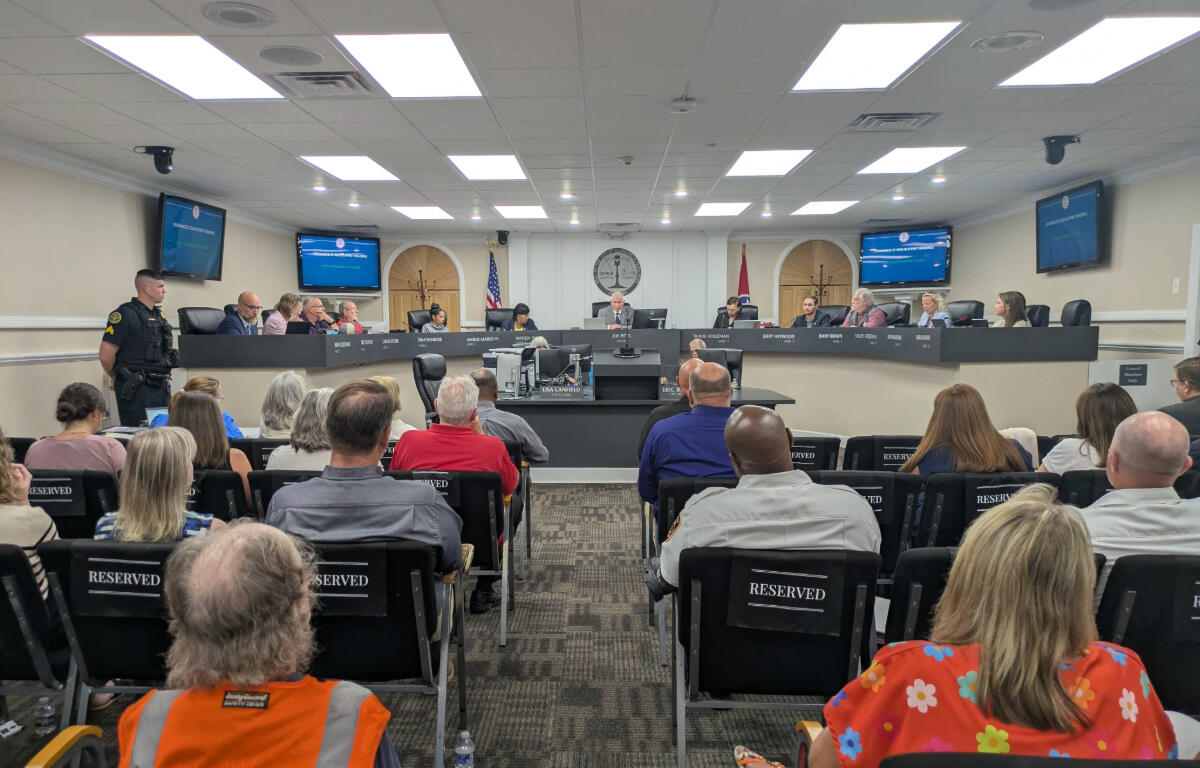
CLARKSVILLE, TN (CLARKSVILLE NOW) – The City Council held a discussion regarding the structure of the city budget that aims to hold a negotiation between the council and the Montgomery County Commission over the split of the local option sales tax.
Councilman Brian Zacharias introduced a presentation over the subject and said he’s spent a lot of time looking over the city’s budget, trying to figure out “why our growth isn’t paying for our growth.”
“What I found was very troubling, so I took that to our CFO Christen Wilcox to see what I’m seeing here is correct. She said yes, it is and sent it out to our city’s financial advisors, so they’ve confirmed this as well,” Zacharias said.
“I want to walk through three things: how we got here, why the tools we are using aren’t working and a proposed solution.” Zacharias said he wanted to be clear up front: This is not about taking money away from the school system; rather, it’s about fixing a structure that makes it mathematically impossible for the city to keep up with its growth.
Zacharias said every number in his presentation comes from the city’s books, Montgomery County’s approved budget, and published reports.
‘City is at the edge of a fiscal cliff’
“Here’s the bottom line … this year’s budget spends $6.9 million more than we bring in. That’s after we raise the rate 9 cents, after this council cut $9.2 million from the mayor’s proposal. We’re covering the difference with reserves. If nothing changes, that gap grows $25 million per year by FY 2031,” he said. “Closing it with property tax alone would take roughly $38 cents on the rate.
“At current service levels, that gap grows to more than $25 million due to inflation and the cost of serving the people that would be living here in FY 2031. And that assumes no new spending, capital projects, no increases in our healthcare costs, no unexpected natural disasters to respond to. Even in the most optimistic of scenarios, the city is at the edge of a fiscal cliff that cannot be avoided under the current budget structure,” Zacharias said.
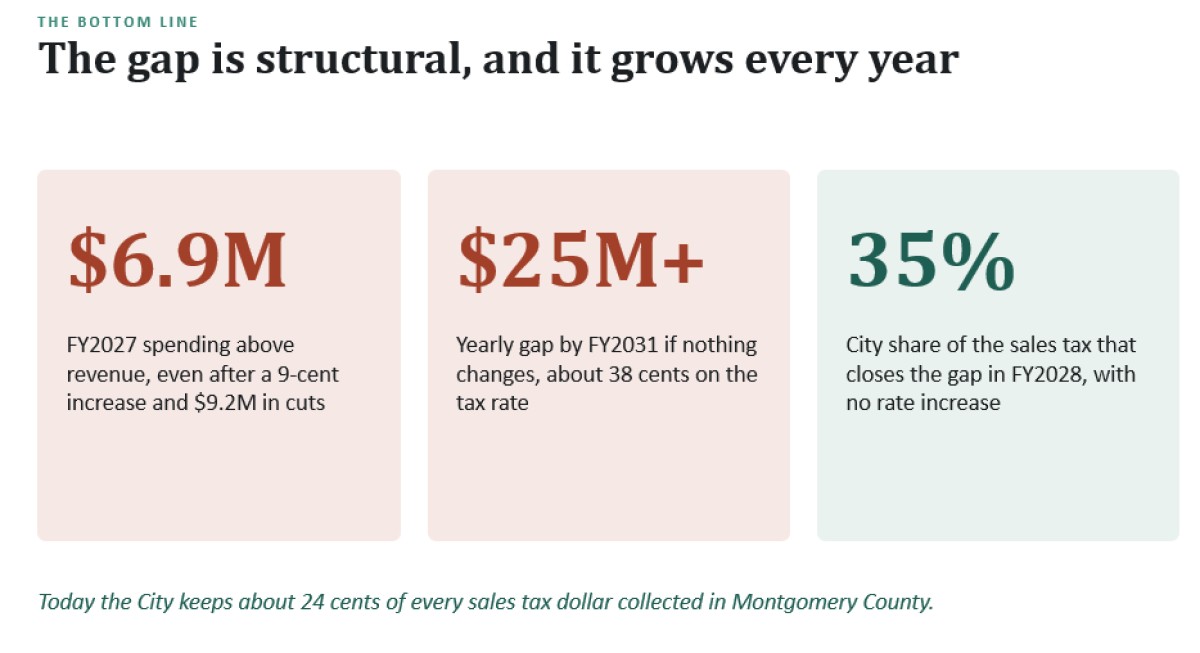
“If the city kept 35% of the local option sales tax, instead of 24%, the gap closes in the first year with no rate increase.”
Zacharias shared how he got to his findings and why fixing the structure of the city budget is dependent on keeping a larger share of the revenue that grows with the city, closing the gap without a rate increase and keeping up as the city keeps growing.
“The City of Clarksville is the economic engine of our county,” Zacharias said. “The chair of the County Commission (Rashidah Leverett) recognizes everybody in the county suffers when that engine is starved of the fuel that it needs; not just the 70% of Montgomery County residents that live within city limits.”
Zacharias said Leverett is willing to bring the county to the table to discuss the restructuring, as well as working toward a solution.
On Friday morning, Leverett told Clarksville Now she attended last night to hear the presentation, as well as council discussion.
“My attendance should not be interpreted as a commitment by Montgomery County to participate in any proposal or study group,” Leverett added. “Any county participation would require appropriate discussion with Mayor Golden and my fellow county commissioners. As Chair, I don’t have the authority to unilaterally commit the County or the Commission to an initiative, nor would I attempt to do so. At this point, I was there to listen and learn.”
3 ways to phase city budget restructuring
He said there are three ways to phase the process of recapturing 50% of the local option sales tax from the county.
- $15 million to the city in year one / 35% in FY 2028, then about five points a year to get to 50%.
- $7 million to the city in year one; about five points a year on a fixed, signed schedule.
- $6 million to the city in year one; schools keep today’s dollars; all future growth goes to the city until the city reaches 50%.
Zacharias recommended stepping up to recapturing 35% of the local options sales tax in FY2028, and he sees option three as the floor. “Every year we wait, is another year’s gaps paid for by city taxpayers.


He then showed a graph that had projections of the city budget based off his three proposed structures, as well as if the current budget structure remains unchanged with its current service levels.
“Why is 50% the target? Because the city provides the day-to-day services that a growing county depends on. Today, we keep less than a quarter that that growth produces,” Zacharias said. “I want to be straightforward what this asks of the county. The county’s FY2027 budget is about $752 million across all funds. The first-year step to 35% is about $15 million, roughly 2% of that budget.”
Suggested ways for county to cover difference
He presented ways Montgomery County could cover the difference in their budget, including spending cuts, a property tax rate increase, shifting services to the city, and/or a combination of all three.
“Two things I want to address up front: I know people will see number two on that list and say, ‘You’re just moving the inevitable tax increase to the county.’ That’s a fair criticism, but in reality, there are some solutions to this problem that would allow a county property tax increase to be offset by a property tax rate decrease in the city.


“To be clear about schools, state maintenance of effort rules protects local school funding. The school’s smaller share of sales tax would be made up by the county. This is not a proposal to cut school budgets.
“The idea is a written framework agreement that settles where we’re going before we settle every detail of how we get there. We agree now on the destination, 50%, a start date no later than FY2028, a deadline for a joint working group to bring back the schedule and protection for the schools’ current sales tax dollars.”
Proposing negotiation between City Council, County Commission
Zacharias said that next month, he’ll be asking the City Council to adopt a resolution inviting the Montgomery County Commission to negotiate the written framework of the city’s budget restructuring. He said he believes the County Commission would have to adopt a similar resolution themselves.
Councilman Eric Claunch asked if Zacharias is willing to see this process through if he’s not elected the next city mayor. Zacharias said yes and that he doesn’t care who sees it through, he believes Clarksville needs this.
Councilman Jimmy Brown questioned what services the city would be taking up that are currently provided by the county. “That would add costs to us,” he said. Brown asked what the City of Clarksville currently receives out of the local option sales tax. Zacharias said around $31 million, or 24%.
Brown also asked what percentage of the local option sales tax is collected inside the city. Zacharias said he believes 97-98%.
“97-98% of the local option sales tax is brought in by the city, but we only get 24% of that,” Brown said. “That’s a big difference there.”
Councilman Carlos Peters said he supports what Zacharias is trying to accomplish with the budget restructuring, but his argument also reaffirms his stance that a consolidated government is needed. “Consolidated government settles this question for all of time,” Peters said.
Councilwoman Wanda Smith said additional time will be needed to review the matter before making a decision.
| BREAKING NEWS PUSH ALERTS: Sign up for our free Clarksville Now app