


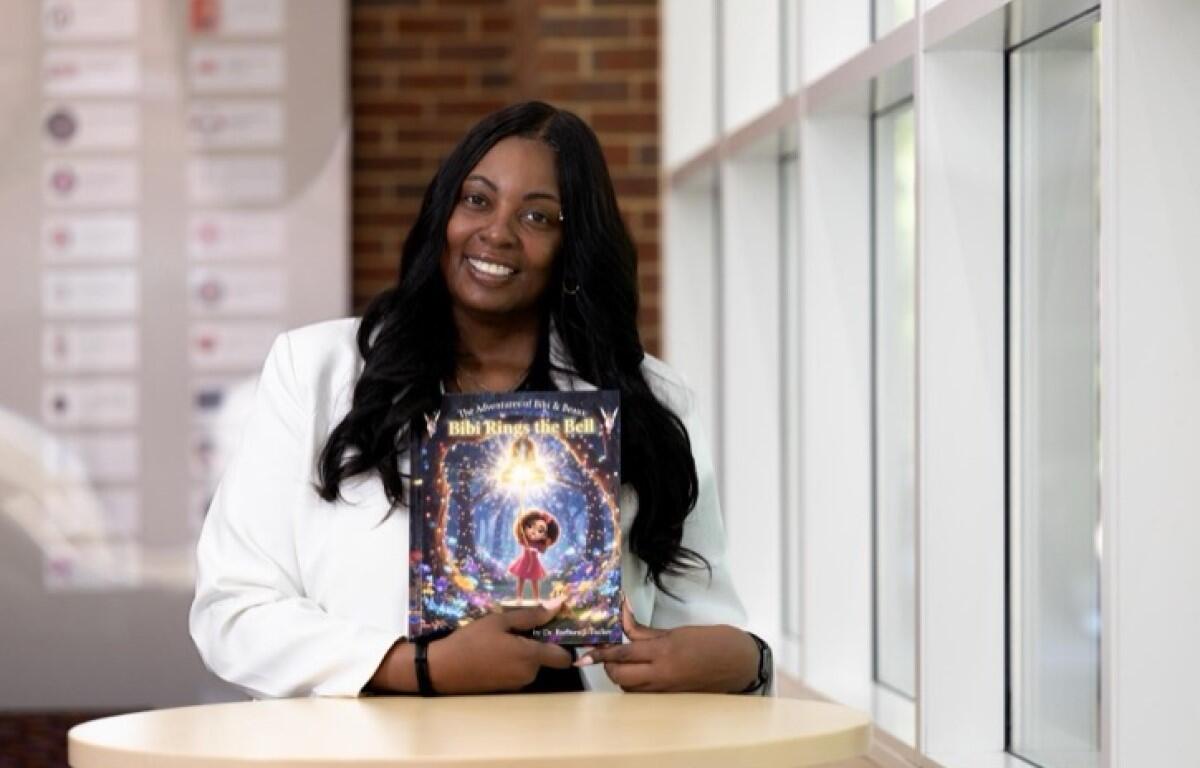

CLARKSVILLE, TN – When doctors diagnosed Dr. Barbara Tucker with a rare brain cancer in 2020, they couldn’t promise she would live to see her son RJ graduate high school.
She made it to the ceremony in May 2021 and kept going.
Nearly six years since her diagnosis, Tucker has become Austin Peay State University’s director of technical services, earned her doctoral degree, and published a children’s book series based on her cancer journey.
Now she is putting The Adventures of Bibi and Beaux into the hands of young patients in children’s hospitals and using her story to advocate for early detection, especially in Black communities with higher cancer mortality rates.
The series follows Bibi and her dog Beaux as they navigate a tumor diagnosis and treatment at the Light Castle, a sanctuary of healers and fairies. Each book draws from Tucker’s experiences to help children and families talk about an illness that is difficult to put into words.
“I really turned into Bibi,” she said. “That’s who I was. I wanted my mom—I needed my mom. I was more of a child when I was sick than I ever was as an adult; I was that kid going through cancer.”
The Diagnosis
Tucker’s journey began in August 2020 with a persistent headache. When she sought medical care for what she thought was a sinus infection, doctors found a 6-centimeter brain tumor.
Within hours, Tucker was transferred to Vanderbilt University Medical Center, where doctors identified her tumor as a meningioma and scheduled surgery. To avoid a COVID infection, she was sent home to isolate.
Just before her operation, her surgeon tested positive for COVID, delaying the craniotomy by 10 days. Tucker hoped the ordeal was over, but weeks later, a nurse called to tell her pathology found a rare non-Hodgkin lymphoma in her brain.
“The first thing I did was call my mom in a panic,” she said. “I kept telling her I was going to die, and she said, ‘No, you’re not. I’m your mom. If you were going to die, I would know.’”
The Treatment
Her mother’s reassurance steadied her, but with the cancer in her brain, Tucker had little time to process before radiation began.
“When I first saw my oncologist, I was still hung up on death,” she said. “I wanted to see my son graduate; that’s the one thing I wanted. She cried with me and told me she didn’t know if I was going to be able to.”
From there, Tucker underwent a constant cycle of treatment, testing, and medication that changed how she saw herself.
“If I touched my head, my hair would come out in my hand like in the movies,” she said. “My skin was discolored, I was exhausted, and the steroids made me gain a lot of weight. I couldn’t stand to look at myself in the mirror.”
Between radiation exposure and COVID risks, treatment kept Tucker largely cut off from loved ones. Her dog Buddy, who inspired Beaux’s character, was one of her few sources of relief.
“Buddy knew something was going on, so he would come peek around the corner to check on me,” she said. “I couldn’t pick him up because I couldn’t bend my head, but he gave me some comfort.”
The Dark Days
Still, the physical and mental toll of Tucker’s illness deepened in isolation.
“I had never experienced depression before I had cancer, but I just couldn’t get out of this dark feeling coming over me,” she said. “Every day felt like I was stuck in a holding pattern.”
One of the toughest parts was that nobody could tell her why she was sick or whether she would survive.
“The doctors told me that if I believed in a higher power, now was the time, and I went through a lot of prayer and reflection,“ she said. “I’m a spiritual person, and at some point I felt like I just had to make peace with the fact that it’s going to be what it’s going to be.”
For Tucker, that realization was not about surrendering the fight; it was about surrendering the fear.
“I bought two necklaces, one that says ‘God is with me’ and another with the Lord’s Prayer,” she said. “Whenever I got anxious or nervous, I held on to them and thought, ‘God is with me. I’m going to be OK.’”
That hard-won peace helped Tucker revisit her lowest point in The Dark Days, the third and most personal book in her series.
“A lot of people deal with depression, and it’s hard to talk about,” she said. “But if I hadn’t gone through the dark days, I wouldn’t have been able to ring the bell—on the other side of the dark days, there is triumph.”
Ringing the Bell
After 10 weeks of treatment, Tucker’s cancer entered remission, and she joined the survivors who ring the bell to mark the end of the fight.
“Since I couldn’t have anybody in there with me, the people who treated me were all there clapping,” she said. “It was great to know it was over, and they even let me pick my music and played Beyoncé because that was my soundtrack whenever I came in.”
Her recovery meant Tucker was in the audience at Northeast High School when RJ walked across the stage, and she watched her daughter Nia graduate from APSU a year later with a bachelor’s in health and human performance.
“Working on a college campus, I witness the excitement and pride of graduation every year,” Tucker said. “It had become routine, something I never questioned … but the truth I came to understand is that time owes us nothing. In one of the most difficult seasons of my life, I was given the gift of more time, and I was able to witness both of my children’s graduations. In those moments, I realized that every second mattered.”
Paying It Forward
Remission did not return Tucker to her previous life. She still manages daily medication, annual scans, and memory gaps, but she left treatment with a new perspective.
“It’s only encouraged me to go for everything I ever wanted,” she said. “Before, I was more hesitant and thought I had time, but now I live with a sense of urgency and purpose.”
Tucker now channels that drive through The Adventures of Bibi and Beaux, having donated copies and companion puzzles to Vanderbilt Children’s Hospital and Gilda’s Club to give young patients something to hold onto.
“Literacy is important to me, and these children spend a lot of time in the hospital,” Tucker said. “Having these books gives them something tangible and colorful to read, share, and look forward to. Ringing the bell is something we all hope to do, especially a child who has cancer.”
Her work is far from finished—she is exploring opportunities for advocacy with children’s cancer research organizations, and new Bibi and Beaux stories about nutrition, follow-up testing, and more are in development. The books are also listed as resources on the National Brain Tumor Society’s website.
Tucker has always wanted the series to reflect every step of a cancer journey, including hardships like depression and loss. Three of its characters are inspired by friends she lost to cancer within six months, and that grief shapes her advocacy today.
“I have survivor’s remorse because I’m still here and they’re not,” she said. “But I feel like they’re with me and telling me, ‘You’re the one that’s here, so you have to keep going. Live with purpose and live for us.’”