


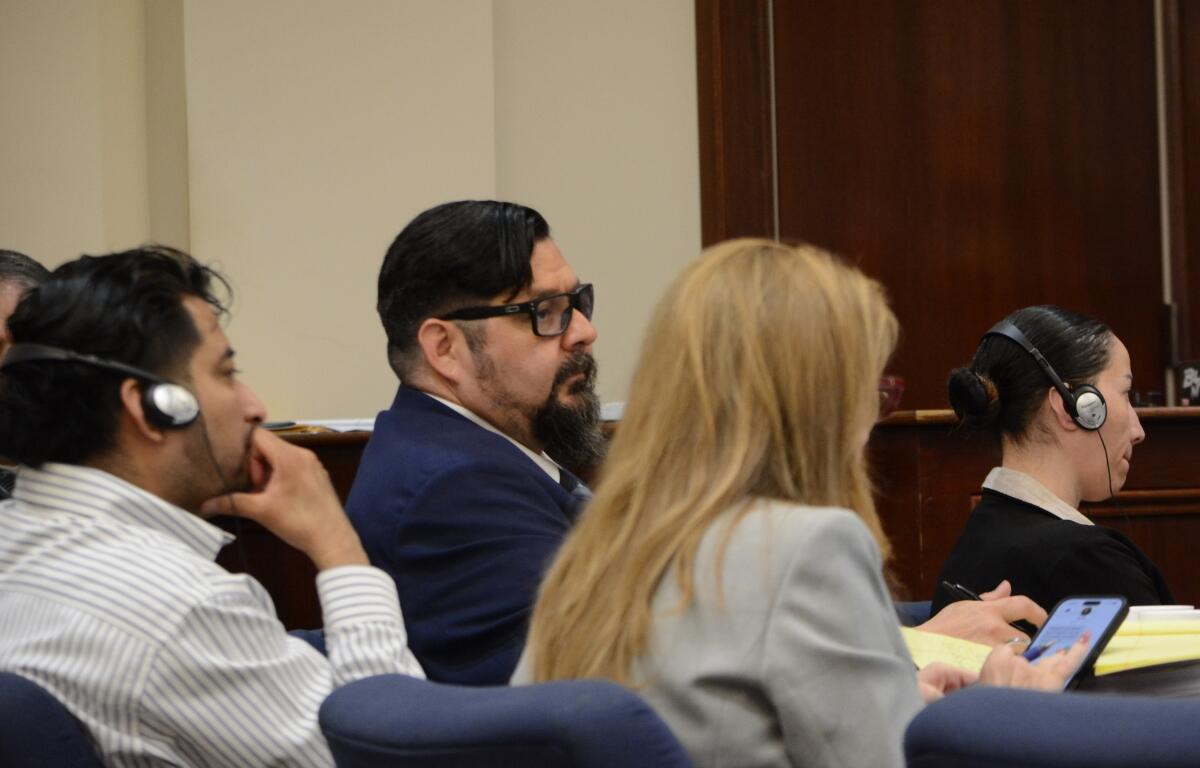

CLARKSVILLE, TN (CLARKSVILLE NOW) – Jurors heard new details about surveillance footage, autopsy findings and blood-pattern analysis as testimony continued Wednesday and Thursday in the trial of the divorced couple charged in the 2024 stabbing death of the man’s new wife, a Fort Campbell soldier.
Sofia Rodas, 37, and Reynaldo Salinas-Cruz, 41, were indicted by a Montgomery County grand jury in December 2024 in the death of Salinas-Cruz’s wife, 23-year-old Pfc. Katia Dueñas-Aguilar, according to previous reports. Court records show Rodas was charged with first-degree murder, and both were charged with tampering with evidence. Both defendants pleaded not guilty to all charges.
Soldier, friend describe victim’s movements before her death
Cpl. Logan Ireland testified that he met Dueñas-Aguilar in March 2022, and that she was his team leader for the 5th Battalion. “She was very knowledgeable,” he said, adding she cared a lot about the soldiers.
Ireland told the jurors he dropped Dueñas-Aguilar off to her car outside Gate 10 on May 17, 2024, after work around 3 p.m. He said she reached back out to him around 6 p.m. because she had forgotten her phone in his car and was getting a ride back onto post to pick it up.
Surveillance cameras and ID scanner logs provided by the chief of physical security showed that Rodas drove Dueñas-Aguilar back on post in a black Jeep around 6:55 p.m. Ireland said when he met up with them to return the phone, Dueñas-Aguilar was wearing a T-shirt and jean shorts.
Maria “Lupita” Martinez-Gonzalez, a friend of Rodas who also knew Dueñas-Aguilar, testified she met Rodas through a mutual friend in 2022. She told jurors she went to Rodas’ home in the summer of 2023, where she met Salinas-Cruz and Dueñas-Aguilar for the first time. Martinez-Gonzalez said, to her knowledge, Rodas and Salinas-Cruz were married. While hanging out, she said the conversation shifted to relationships. “Well Katia said that she wanted to get divorced, but she couldn’t do it because she didn’t have any money,” she said.
| NEWS ALERTS: To get free breaking news alerts on your phone, text the word NEWS to 43414.
Martinez-Gonzalez told jurors that Rodas suggested marrying one of the men that worked with Salinas-Cruz, adding they would financially compensate her for doing so.
On the night of May 17, 2024, Martinez-Gonzalez said Rodas invited her out for dinner and drinks at a restaurant on Riverside Drive. She said Rodas drove herself and Dueñas-Aguilar there in a Jeep, arriving around 7:10 p.m. Martinez-Gonzalez said Rodas used to work at the restaurant they went to, and that they were served by a waiter she previously had a romantic relationship with. During dinner, she said Dueñas-Aguilar mentioned possibly wanting to have another child and Rodas discouraged the notion, noting Rodas herself could no longer have kids.
Martinez-Gonzalez told jurors the table had three margarita pitchers and multiple shots of tequila. She said Dueñas-Aguilar expressed not wanting to drink because she did not want to throw up and that Rodas told her not to worry about it. She added that Rodas bought a bottle of Patron tequila.
When Dueñas-Aguilar’s phone died and she asked to charge it in the car, Martinez-Gonzalez said Rodas told her no and said they would just leave instead.
Surveillance video from the apartment complex where Rodas had helped Dueñas-Aguilar move out of days earlier showed a black Jeep entering the fully gated community around 10:54 p.m. that night and leaving around 12:18 a.m. Martinez-Gonzalez said the following week, Rodas called her on May 21 and told her about Dueñas-Aguilar’s death. “Sofia had told me she had just found out from the news,” she said.
Medical examiner: At least 68 sharp-force injuries
Dr. Brianne Flynn, a forensic medical examiner, testified about the results of Dueñas-Aguilar’s autopsy. Flynn told jurors the victim suffered at least 68 “sharp-force injuries,” including at least 55 stab wounds and 13 cuts. “I say at least because some of the stab wounds were overlapping and it could have been two or more in the same space,” she said. “But because they are overlapping, it’s hard to say exactly.”
Flynn said Dueñas-Aguilar sustained injuries to both sides of her neck, the top of her shoulders, her chest, the back of her head and upper back. The wounds injured the carotid artery, her esophagus, severed the jugular vein and caused both a epidural and subdural hemorrhages. Flynn testified that the injuries to the jugular vein and carotid artery were “lethal on their own,” but that even without those injuries, Dueñas-Aguilar would have died just from the “sheer number of injuries.”
Flynn also described lividity – purplish discoloration indicating body position after death – on Dueñas-Aguilar’s thighs. She said lividity begins developing about 30 minutes to two hours after death and becomes fixed between about eight to 12 hours, though environmental factors can affect timing.
| SHARE YOUR NEWS: Email your news releases to news@clarksvillenow.com
Flynn said the discoloration would be consistent with a death occurring in the late hours of May 17, 2024, into the early morning hours of May 18. She noted Dueñas-Aguilar had “no defensive wounds,” and that injuries to the larynx and voice box could make it difficult to breathe or speak.
Investigators describe crime scene and blood evidence
Sgt. Joel Gibbons with the Clarksville Police Department testified that he responded to the scene around 10 p.m. as a crime scene technician. He said Dueñas-Aguilar was wearing denim shorts and a T-shirt, and her body was covered with a bathroom rug. He held up the rug that was recovered from the scene for jurors.
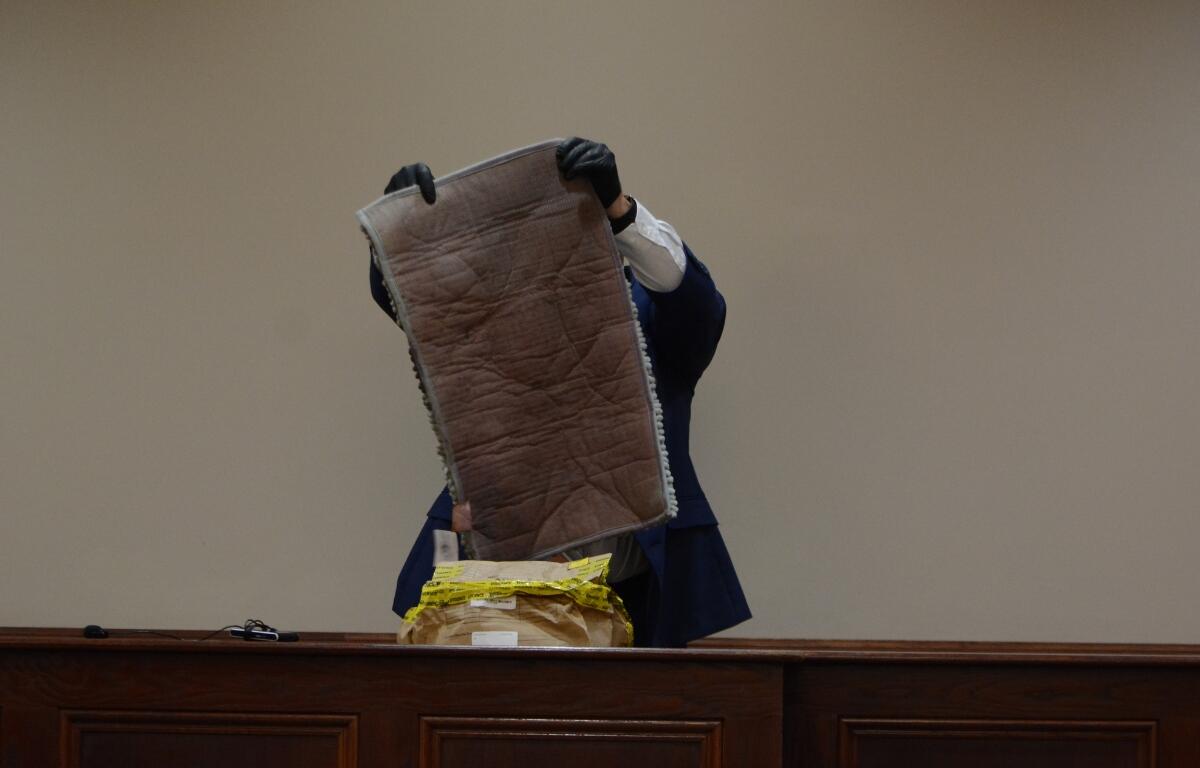
Gibbons also noted the blood on the closet walls where Dueñas-Aguilar was found and the black clutch purse “directly behind her.” He told jurors the purse included her ID and some credit cards, adding the scene was not consistent with a robbery or burglary.
He also noted there was laundry detergent, bleach and other “household cleaners” in the living room. “It seems they were moving in or moving out — that wouldn’t be unusual,” Gibbons said. Another officer recovered a knife from the kitchen with “reddish-brown stains” on the blade, suspected to be blood.
Special Agent Sebastian St-Amand, a forensic scientist with the military’s Criminal Investigation Unit, testified that “saturation stains” were present on the bathroom rug, carpet and clothing from continuous blood accumulation.
St-Amand said the blood stains on the walls, floor, Dueñas-Aguilar and her clothing indicated there was “minimal to no movement” during or after the attack.
Toxicologist: Victim had 0.161 BAC
Dr. Sherri Kacinco, a forensic toxicologist with MNS labs, testified that Dueñas-Aguilar had a 0.161 BAC. She said alcohol is a “central nervous system depressant” that can slow breathing, heart rate and reaction time.
At that concentration, Kacinco said some people may experience blackouts, lowered inhibitions and “an inability to react to stimuli” around them. She said the increasing BAC can lead to dysphoria – a feeling of depression or disconnection from one’s body.
Kacinco said tolerance can affect outward signs of intoxication. She added that someone would still experience the described effects, but that the degree can differ based on tolerance.
She also noted that GHB was found in Dueñas-Aguilar’s blood at a “concentration of 30 micrograms per milliliter.” She said GHB can be produced naturally in the body and that the amount found was within normal limits for a post-mortem specimen.
Court recessed Thursday evening and is scheduled to resume Monday at 8:30 a.m. at the Montgomery County Courts Center.
| GET YOUR LOCAL MORNING NEWS: Sign up for our free daily email newsletter.