



CLARKSVILLE, TN – As traditional entry-level jobs disappear, Austin Peay State University’s College of Business has spent the last several years pushing students out of the classroom and into real organizations through a 37% jump in experiential learning participation.
Faculty have reason to move quickly: Randstad reports a 29% drop in entry-level positions since 2024, while the World Economic Forum found 63% of employers cite skill gaps as a major barrier over the next five years.
Research shows that experiential learning directly addresses that gap. The National Association of Colleges and Employers (NACE) has consistently linked it to greater job opportunities and higher pay, among other benefits that extend beyond the early career. The practice also helps professors stay updated on business trends, as they assess and adapt their experiences to meet current demand.
At APSU, Drs. John Volker, Vikkie McCarthy, and Mike Phillips have decades of combined research and experience creating hands-on experiences that help students build foundational skills employers value, such as critical thinking, communication, leadership, and technological fluency.
McCarthy, a professor of management, continually reviews learning objectives, decides which would benefit from authentic application, and develops experiences that connect students with real organizations, clients, or community partners.
“Traditional assignments have an important place, particularly for developing foundational knowledge and analytical skills,” she said. “But when students need to practice communication, problem-solving, leadership, or strategic thinking, experiential learning almost always produces richer outcomes.”
Volker, a management professor who teaches artificial intelligence (AI), says his courses in prompt engineering and generative AI aren’t treated as shortcuts; they train judgment, a skill that is increasingly important with AI integration into workplaces.
“One of the most surprising outcomes has been watching students discover that the quality of AI output often reflects the quality of their own thinking,” he said. “They assume AI will provide quick answers, but they learn that meaningful results require critical thinking, context, judgment, and reflection.”
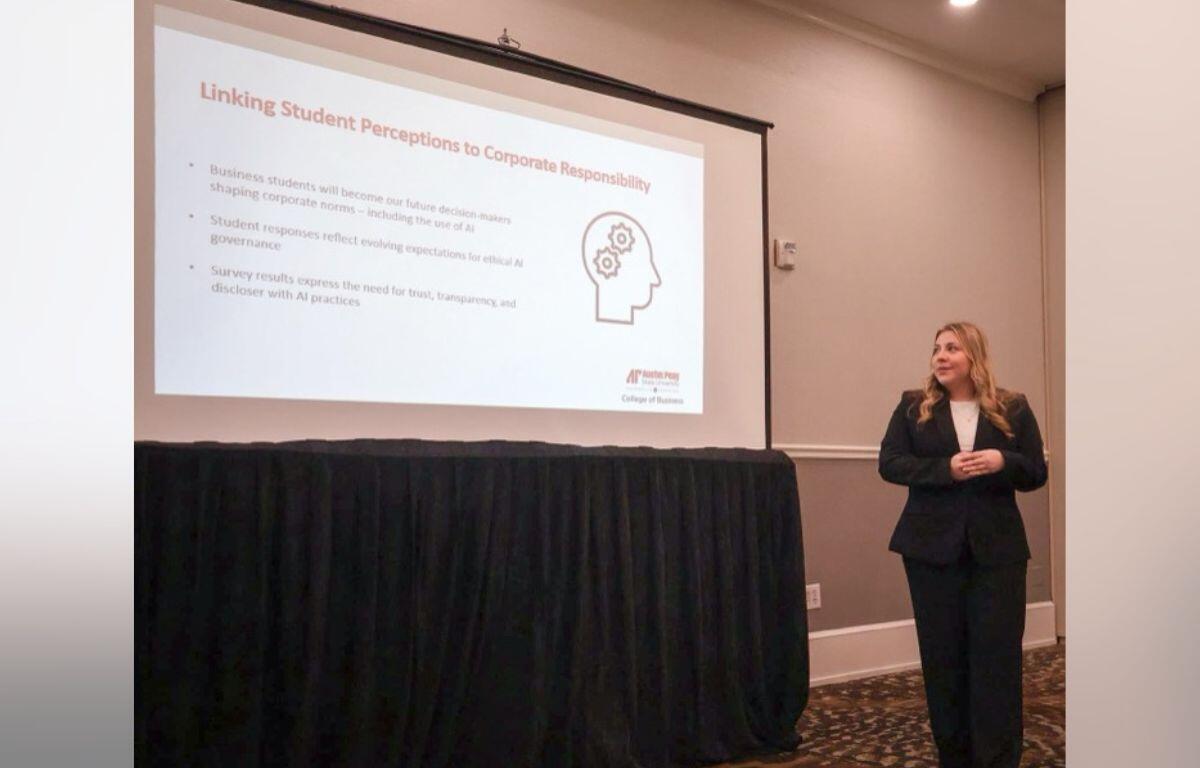
Volker has also worked with students on research projects on the impact of generative AI on business and education. Several have presented at regional academic conferences, engaging with faculty, researchers, and professionals from outside the university while building confidence.
Avery Neufeld, an MBA student, said working with Volker strengthened her use of AI tools and her understanding of the ethical implications, reinforcing the importance of using AI responsibly, not as a replacement for decision-making.
“One of the biggest changes in my approach was learning to question AI information rather than accepting it at face value,” she said. “I now evaluate whether credible sources support the information, reflect current research, and may contain bias or omit important context. The experience has shown me that using AI tools requires strong communication skills, critical thinking, and thoughtful evaluation.”
Volker says it’s obvious when students are benefiting from the interactive lessons because they speak confidently and stop asking him to validate their answers.
“They start defending their own ideas—to classmates and, increasingly, to scholars and other professionals,” he said.
Students are learning more than technical skills. McCarthy said she was surprised at how quickly her students developed professional confidence during a collaboration with the Chamber of Commerce and independent restaurants, where they gathered data, listened to owners’ challenges, and documented neighborhood businesses’ economic contributions. The application and recall of their coursework were evident as students began speaking with owners as peers.
“They asked thoughtful questions, built genuine relationships, and often uncovered insights that hadn’t been captured elsewhere,” she said.