



CLARKSVILLE, TN (CLARKSVILLE NOW) – Crucible Metals, which is building a massive new smelter to replace the existing Zinc Plant, invited community members to attend a public information session this week to learn more about Korea Zinc and Project Crucible.
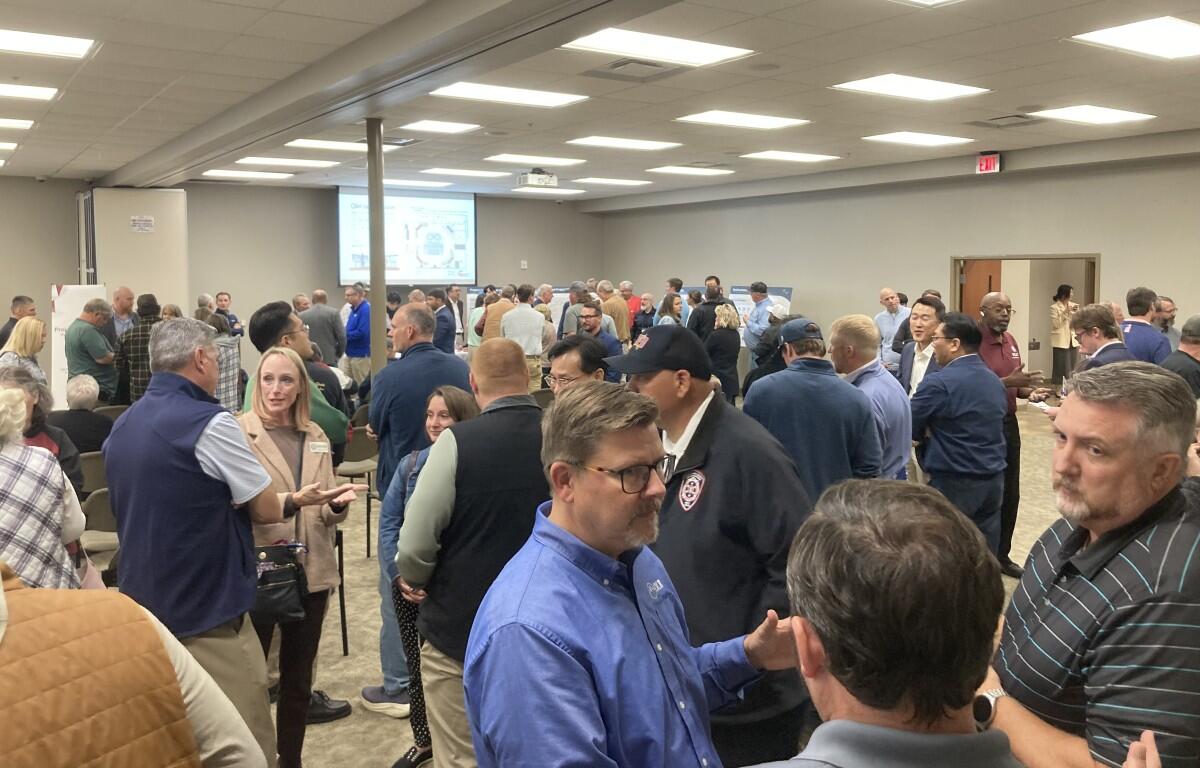
More than 150 people attended the event on Tuesday, ranging from business leaders to subject matter experts to curious residents.


Dellinger: ‘Continuation of relationship with South Korea’
“Clarksville-Montgomery County is excited about this project not just because it’s historic for the state of Tennessee, but because of the jobs it will provide, the updates it’ll make to an existing facility and the increase in the property tax base for the county,” said Buck Dellinger, CEO and president of the Clarksville-Montgomery County Economic Development Council.
Dellinger said the community already has a great working relationship with South Korean companies, with an exceptional experience over the last 15 years. “Crucible Metals is a continuation of that relationship with South Korea,” he said. “From their first visit to the county, Korea Zinc leadership has been transparent and impressive with their environmental record and commitment to protecting the environment.”
President of Korea Zinc on Clarksville vision
Kiwon Park, president of Korea Zinc and Project Crucible, spoke about the success KZ has had in other communities, such as in Townsville, Australia, with the Sun Metals Zinc Refinery. Park said that facility is considered a world-class refinery, strengthening the region’s economy, creating good-paying jobs and supporting local business through continued investment.
Three employees from the Sun Metals Zinc Refinery in Australia came to Clarksville for the meeting so they could address any concerns or questions.
“What has made us both successful in South Korea and Australia? I believe the answer lies in our mission,” Park said. “Our mission is clear: to transform diverse, low materials and energy sources into valuable materials and usable energies.”
Environmental responsibility, top priority being people
Park said a second part of his organization’s mission is to develop the product in the safest, most environmentally responsible and efficient way possible.
“Our growth has been achieved and shared with our employees, their families and the local communities we serve,” Park said. “We believe when a company succeeds, its surrounding community should thrive as well. That belief has been at the core of our journey.”
Officials shared videos as part of the presentation.
Project Crucible’s refining technology
Steven Merkley, the general manager of Crucible Zinc, said many of the technological advancements at KZ have been developed in-house.
“Technologies that they are bringing to the Clarksville area, they are really world-class technologies,” he said. “When you work at doing something and consistently improving day after day, you tend to develop and find the most efficient ways to do the function you are performing. In this case, it’s producing metal.”
Merkley reiterated a high priority has been placed on environmental responsibility, as well as the health and safety of their employees. “Which is really important to me as the leader of the team that is currently producing zinc here in Clarksville,” he said. “In Korea, they produce over 20 metals at their site, it’s the largest nonferrous metals smelter refinery in the world. And this applies the needs of the modern industry.”
Merkley said throughout his 20-year career working in metals processing, most sites produce two to five metals, however, this new site in Clarksville is expected to produce 12.
Merkley: What is Project Crucible? What’s the timeline?
Merkley said he couldn’t have thought of a better outcome than replacing the existing zinc plant, given its history and age, with a state-of-the-art smelting and refining facility.
“The facility’s going to recover and find multiple critical minerals and metals at this single location. Primarily it’ll be lead, zinc and copper, but there will be many other precious rare metals,” he said. Those include silver, indium, antimony, bismuth, tellurium, palladium, gallium and germanium.
Merkley said the facility’s design will be based on Korea Zinc’s proven technology, and it’ll be adapted to U.S. engineering regulatory standards.
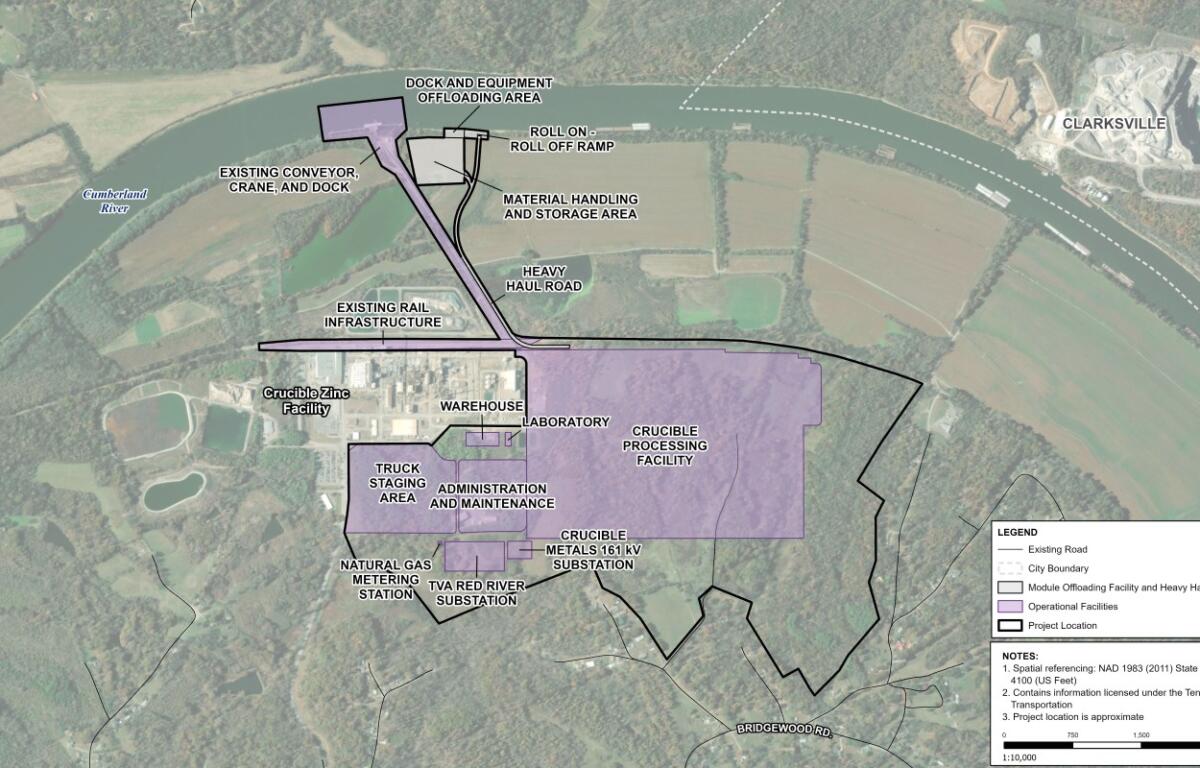
As for the rough timeline, the existing zinc plant remains in operation, renamed Crucible Zinc. Merkley said site preparation for the new replacement smelter next door is underway as the design is being refined and the permitting process is unfolding. “Construction is scheduled to commence in 2027, and then we’ll assume operations in 2030,” he said. Once the new smelter is up and running, the old zinc plant will be shut down and eventually removed.
How will Project Crucible contribute to United States?
Merkley said Korea Zinc has the highest global market share for metals such as zinc, lead and sliver. “As a result, this facility that we’re going to construct in the United States is going to have a huge impact on critical minerals and metal needs that the American economy has,” he said.
“One of the benefits the United States will get out of that is a secure, reliable domestic supply of these critical metals and minerals,” he said.
Merkley said the production of the different minerals and metals is vital to the economy for AI, batteries, advanced manufacturing, semiconductors, as well as national defense. “Korea Zinc is really bringing advanced refining capabilities to U.S. soil. This will support our supply chain diversification, economic growth and long-term industrial competitiveness,” he said.
How will facility be different from existing one?
Merkley said the current zinc plant is 50 years old, with mostly 50-year-old technology.
He also said the new facility will be larger with new equipment, infrastructure and of course processing capacity. “At the current site, it processes 200,000 tons of concentrate. When the new facility is at full capacity, it’ll be about 1 million tons of concentrate for Crucible Metals,” he said. “From an environmental performance point of view, it’ll be second to none.”
Merkley said some equipment and infrastructure will be reused, however.
Merkley also said Korea Zinc doesn’t leave anything on the table in terms of product. “You dig the dirt anyway; you might as well get all of the valuable stuff out of it and leave no water. That’s what Korea Zinc is doing and what we’re going to do at the Crucible Metals facility,” he said.
Modern emission controls, dust collection and off-gas treatment systems are also set to be a part of the new facility. “What that translates to is clean air; it’s going to be a clean discharge facility,” Merkley said. “There is some new lead smelting process that Korea Zinc is bringing to the Crucible Metals facility to minimize dust and emissions during material handling.”
Why was Clarksville selected?
Merkley said Clarksville was chosen because it’s central to a lot of heavy industry in the Northeast and Midwest.
Plus, Clarksville has strong transportation, infrastructure and logistic networks. “So, the current site has a rail that goes through it. It is adjacent to the Cumberland River,” Merkley said. “And I won’t talk about roads in Clarksville, but the rail of the river is key to this project. It’s excellent logistic networks and has a skilled workforce.
“If you don’t know, the Clarksville smelter is the only operating primary zinc smelter in the United States; it’s the last one. So, you cannot find people who are experienced in smelting and refining zinc, so the workforce is a part of that.”
Merkley said the business environment also contributed to Clarksville being selected and that the state, county and city have all been the best of partners.
During construction, the project is expected to have a “massive” economic impact, with up to 5,000 temporary jobs being offered between 2027 and 2030, Merkley said.
What’s next for Project Crucible?
Merkley said more than 14 state and local permitting processes are involved in the approval and construction of Project Crucible. Continuous environmental monitoring and management plans will continue to be addressed once up and running as well.
After the presentation, experts at three locations on topics if environment, construction and project/community information met individually with attendees.
Korea Zinc spokesperson Jihye Shin said a website will be made available with an email address for community questions and concerns, and they will share details once it launches.
| PREVIOUSLY:
- 6 things to know about plan for Crucible Metals: Jobs, bridge, not just zinc
- Nyrstar completes sale of zinc plant, mining complexes to Korea Zinc
- Korea Zinc launches $6.6B ‘Project Crucible’ refinery project
| ADD US ON GOOGLE NEWS: Click here to see more local news from Clarksville Now