



CLARKSVILLE, TN – From group projects and presentations to lab work and case studies, Austin Peay State University has always provided opportunities for career readiness — but now, professors are directly embedding key job competencies into their courses as part of a larger $2.5 million federal grant awarded to the University College.
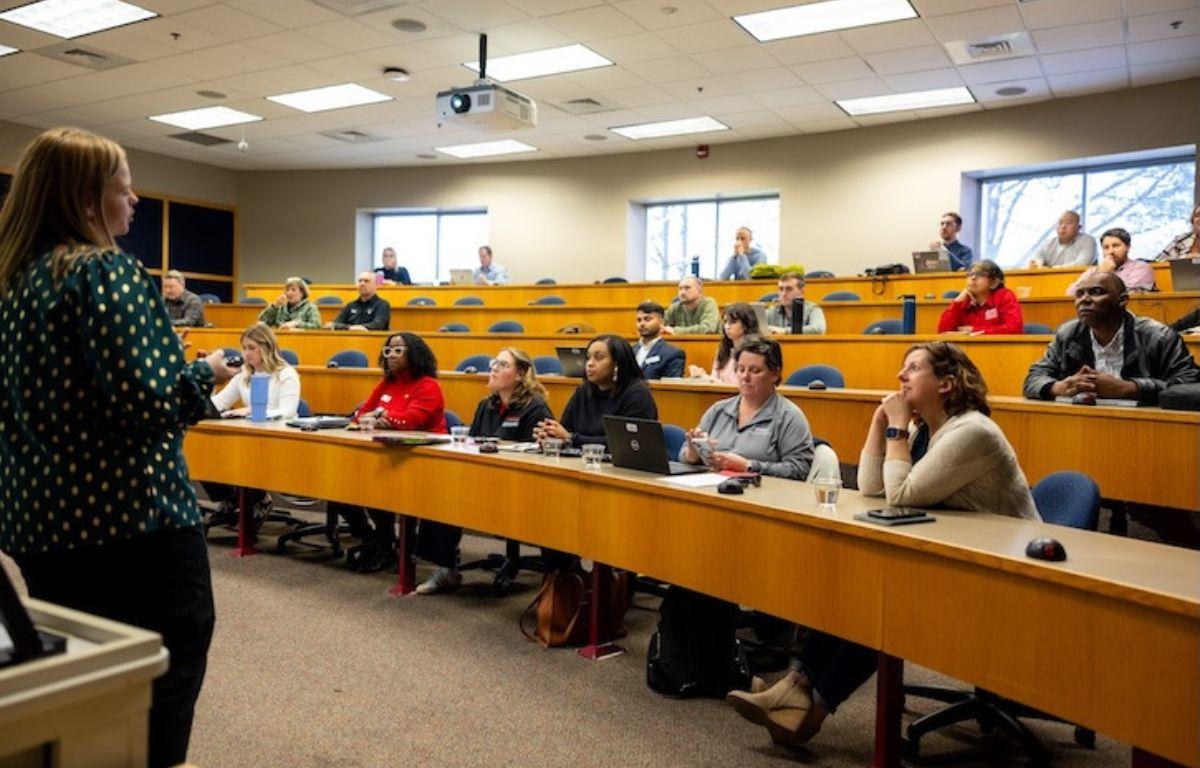
A portion of that funding recently allowed 16 faculty members from across campus to participate in the Career Readiness Academy, an extended workshop series focused on labor market tools, curriculum development, and National Association of Colleges and Employers (NACE) competencies.
“With this program, we’re really wanting to focus on increasing student knowledge, confidence, and preparedness,” said Dr. Kacie de Saint Georges, executive director of University Partnerships and Success Initiatives. “Making sure our students understand how their activities and assignments are helping them develop these career competencies that employers are expecting is very important.”
After learning about Austin Peay’s labor market tools, including Lightcast and Forage, faculty members were able to create, implement, and update course materials to improve career readiness outcomes starting in the Fall 2025 semester.
Dr. Alex Adams, an assistant professor in the Department of Health and Human Performance, applied what he learned to an introductory class for students who want to become physical education teachers or coaches.
“Some of the skills I really wanted to focus on were professionalism and communication, and we did that by adding a field observation,” he said. “Students had to do one hour of observation at elementary, middle and high schools, and they had to write ‘welcome’ and ‘thank you’ emails to make sure they were practicing their professionalism.”
The students also taught simulated lessons in small groups throughout the semester, kept journals on their observations, and developed their teaching philosophies. Adams plans to incorporate observations of athletic events, practices, or training sessions into future classes.
“A lot of these students want to be coaches at a college or high school, but they ended up feeling more comfortable presenting in front of groups,” he said. “They felt more affirmed in their profession, and more confident about teaching psychomotor and cognitive lessons in front of others.”
Dr. Tracy Nichols, an associate professor in the Department of Communication and the assistant director of Honors and PELP, incorporated lessons from the Career Readiness Academy into APSU’s public speaking course for Honors and PELP students.
“One of my passions is service learning, and for this class I wanted a small, value-driven project that students wouldn’t feel was taking too much of their time,” she said. “The students told me their interests, and I found nonprofit organizations in town for them to spend five hours with. It wasn’t just volunteering; they had to unpack information based on what they were learning in class, present about what was going on with their organizations, and network while spending time in the community.”
Class discussions and reflective assignments further helped the students connect their assignments with career competencies, and they closed out the semester with a showcase for community partners.