



Commentary by Chris Smith, editor-in-chief of Clarksville Now.
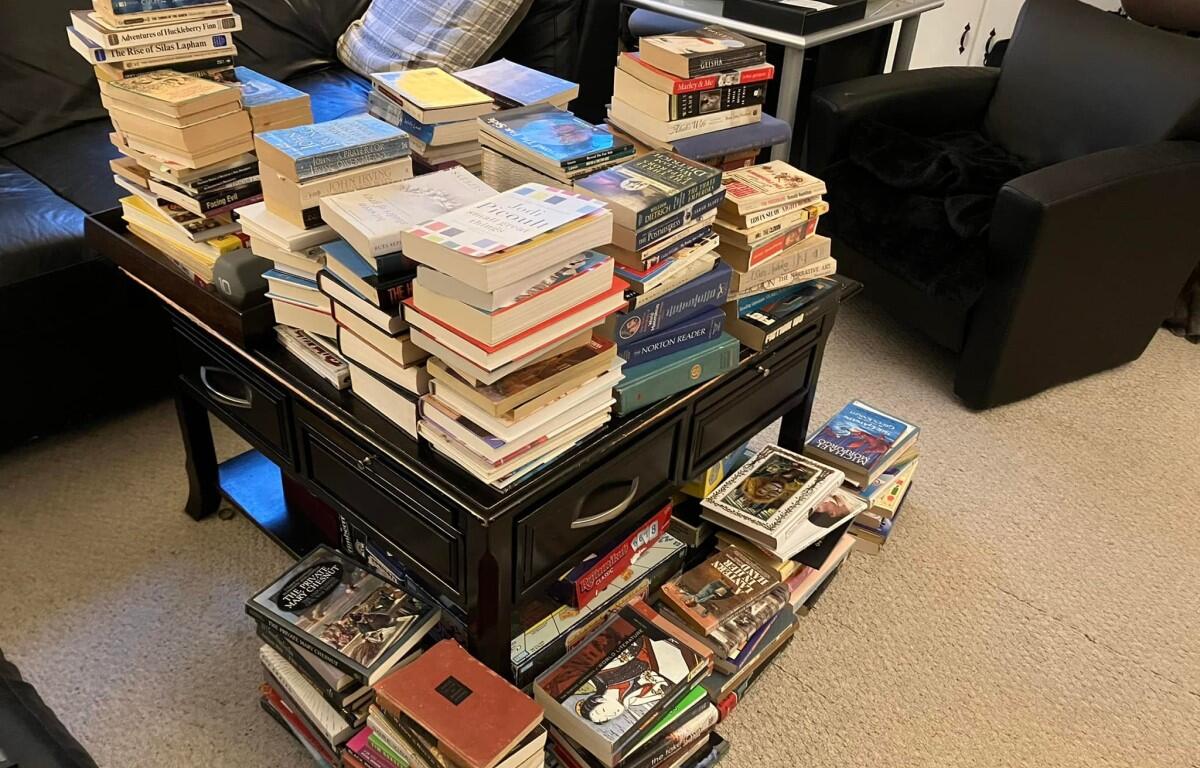
We have a problem – a book problem.
We can easily get rid of old clothes. My oversized sweaters from the early ‘90s will never come back in style, surely, and if they do, they won’t come back in muted rainbow horizontal stripes. The version of me who wore Bugs Bunny cartoon ties to work every day for about a decade definitely had a “look,” but that look has been replaced by Chuck Taylors with blazers – much more refined and professional.
We can easily get rid of old furniture. The Wife and I have a basement full of chairs and tables and desks that we’ve accumulated since college, intending to pass them off to our kids when they ended up in desperate times like we did, sleeping on empty floors in unfurnished roach-friendly apartments. Not like they appreciated this at all. “Um, no Dad, I think I’ll go find something at Habitat” is the response I got when offering up the bureau that has only a little bit of mildew, really, and just needs the cobwebs brushed off. (They’ll be sorry when they go to Habitat and end up accidentally buying the furniture I donated because they didn’t want it the first time around.)
But books. How do you get rid of books?
No, you will never read ‘Ulysses’
Like many people who enjoy reading, we don’t easily let go of the books we’ve read. In some cases, we might want to read them again. (But how many more times can I read Fight Club?) In other cases, they’re like trophies of accomplishment. (Yes, I read the Complete Works of Shakespeare and bespeak my pride o’er those works by faith.) Some are still out there waiting to be read, like angry ghosts howling for attention. (Ulysses, Catch 22, The Fifth Circle – I know, I hear you, and I’m not gonna do it!)
Mostly, they hold a special place in our hearts. The Fire Next Time had chills going up my spine with furious indignation. A Farewell to Arms I threw across the room and dropped my head in my hands, crying. William Gay’s Provinces of Night is so heavily underlined, I might as well have underlined the whole thing.
They become treasures, these books. Like family photos or souvenirs, only capturing a place in our imagination instead of time and space.
But when the books are all lined up, side by side, and then more books are stacked on top, and then small piles start accumulating in corners? Well, the TV show “Hoarders” started somewhere, didn’t it? And using books as load-bearing walls probably doesn’t meet local building codes.
Of course, we recently had a special opportunity: Shifting from a household of five to a household of two meant a lot of these books could go, and go they did.
‘Goodnight Moon’ isn’t going anywhere
Before you grasp your chest in shock, or pick up baseball bat to come after us, no, we did not get rid of our children’s books. Tacky the Penguin, Sheep In a Jeep and dozens more have a special bookcase of their own awaiting story time with our grandkids, which can’t come soon enough. (No pressure, though!)
We did, however, take a hard look at that shelf of gardening books, considering that no one in this family has gardened since 2005. As much as I love all the novels we accumulated in college, do we really need two yellowed paperbacks of Great Gatsby? And the shelves and shelves of homeschooling books, I swear The Wife could start a school of her own.
The book purge led to some honest conversations. “Have you read these James Patterson books?” “One of them, I think.” “Do you like James Patterson?” “Actually, no.” “Then why do we have a shelf of James Patterson books?” “… I have no idea.”
There’s also the reference books. Back in my day – before we had Google in our pockets – we’d sit around after dinner parties with friends and end up in some quandary over where the phrase “turtles all the way down” comes from, when the TVA dam system was created, or what the difference is between a dolphin and a porpoise. To answer these questions, we accumulated a collection of now wine-splashed reference books, like The Way Things Work, Masterpieces of World Literature, Familiar Quotations and Star Trek Encyclopedia. All of it replaced by raising your wrist and saying, “Hey Google …”

The book purge took the better part of a day. There were arguments, there were tearful goodbyes, there were heart-warming kisses on battered dustcovers, and we ended up with eight barely liftable boxes of used books, all of them donated and now in better hands and deeper shelves. As for our shelves, we can now actually see the books that we have, instead of them being obscured by knickknacks and photos, which have breathing room in the empty spaces between.
Until we get more books.

Daddy Overboard is a limited series on life as empty-nesters.
PREVIOUSLY: