


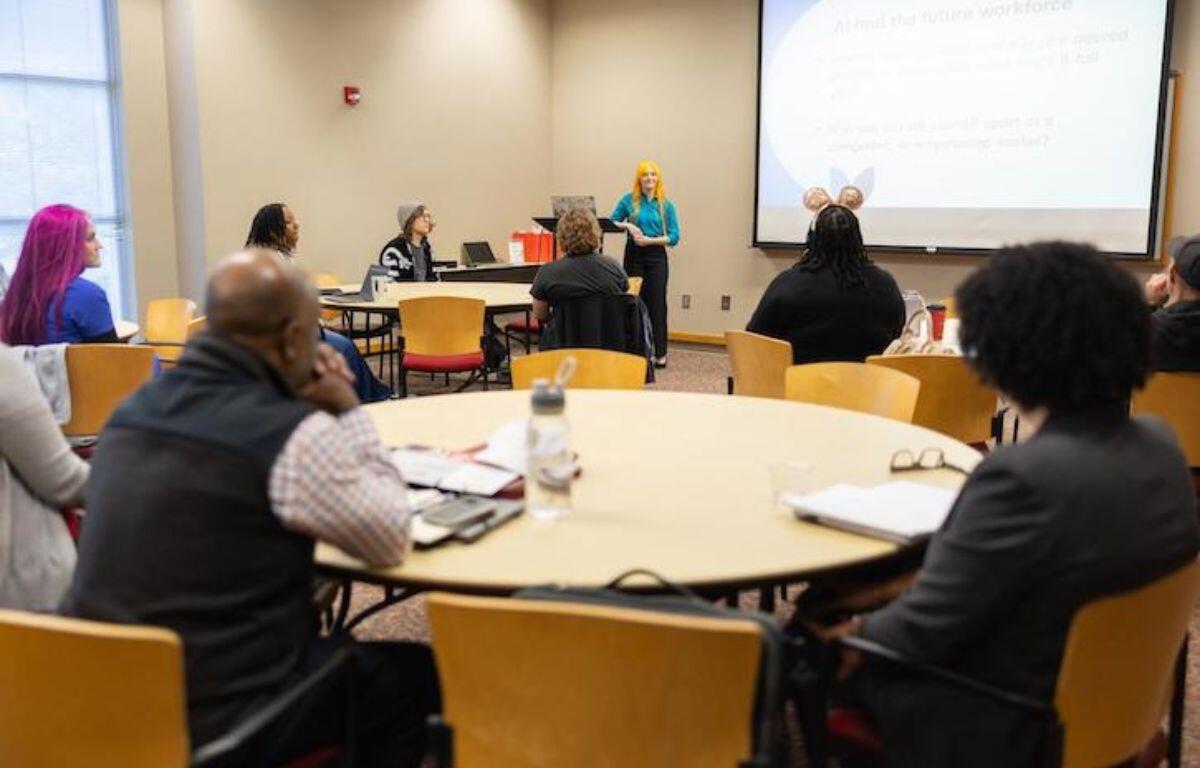

CLAKRSVILLE, TN – Austin Peay State University’s AI Symposium broke new ground this year by featuring student presenters alongside faculty and staff, with participants leading a campus-wide conversation about artificial intelligence.
The daylong event drew participants from across campus for 16 interactive sessions and a keynote address exploring AI’s potential in education, research, and professional practice. Students who shared their expertise included Rhianna Loy, Sarah Ahlheit, and Camara Wilson.
“This symposium represents our commitment to making AI literacy accessible across all disciplines and experience levels,” said Dannelle Whiteside, APSU’s vice president for Legal Affairs and Organizational Strategy. “The students who presented are showing us the future of AI integration in education, and their willingness to engage critically with these tools is the kind of thoughtful approach we want to foster across campus.”
Loy’s presentation drew on her experience in a library science course taught by Assistant Professor Scott Shumate and Associate Director of Library Services Jenny Harris. It was designed to address a gap in how students approach the technology.
“I’m a big advocate for spreading awareness of the proper ways to use AI, because I feel like a lot of students are very much all or nothing,” said Loy, a junior English major. “Either they’re very enthusiastic and comfortable with it, or they avoid it entirely because they don’t know how to use it in a way that abides by academic integrity—but it can be a very helpful tool if you know how to use it.”
The session emphasized prompt engineering techniques that allow AI to function more as a tutor, and opened a dialogue between students and faculty about AI policies in the classroom.
“That was my very first time presenting,” Loy said. “I have anxiety, so it was very nerve-wracking, but it was such a great experience, and I had the support of all the staff and my professors. It definitely added to my confidence a lot.”
Loy’s talk went over well with attendees, and she was invited to return for a virtual presentation on the same themes at next year’s AI Symposium. She is already planning to broaden the discussion to include major AI developments and specific policy recommendations.
“I would love to see the library class that I took become a required course for freshmen, because the nuances of information literacy and AI literacy aren’t taught in other classes,” she said. “They’re either skimmed over, or you’re assumed to have already learned that information. Making it a general education class is a way for students and faculty to have more open conversations about AI expectations.”
Wilson’s presentation explored a more specialized use case: pairing augmented reality (AR) glasses with AI chatbots to provide social cues for people with autism spectrum disorder. He realized the idea’s potential while watching showcases for Meta’s AI-powered smart glasses and the Apple Vision Pro.
“I’ve got family members who are on the autism spectrum,” said Wilson, a junior health and human performance major. “I believe that helping them is going to realize some of the dreams they have, because communication is a back-and-forth process.”
His proposal centers on AR glasses that would support therapy for people with autism by offering conversational prompts, accounting for users’ personal preferences, and helping them identify social cues.
“For individuals on the autism spectrum, this could help with their daily lives and emotional regulation,” Wilson said. “The glasses could listen to a conversation based on permission from the other person to record and interpret, then filter that information to offer assistance.”
Wilson also discussed the ethical and privacy considerations that would be involved in using the technology, emphasizing the need for consent and user control. “We’re all humans, and we all experience things so differently,” he said. “I want to help people with autism open up a world of possibilities, and for their communication to come across to everyone.”