


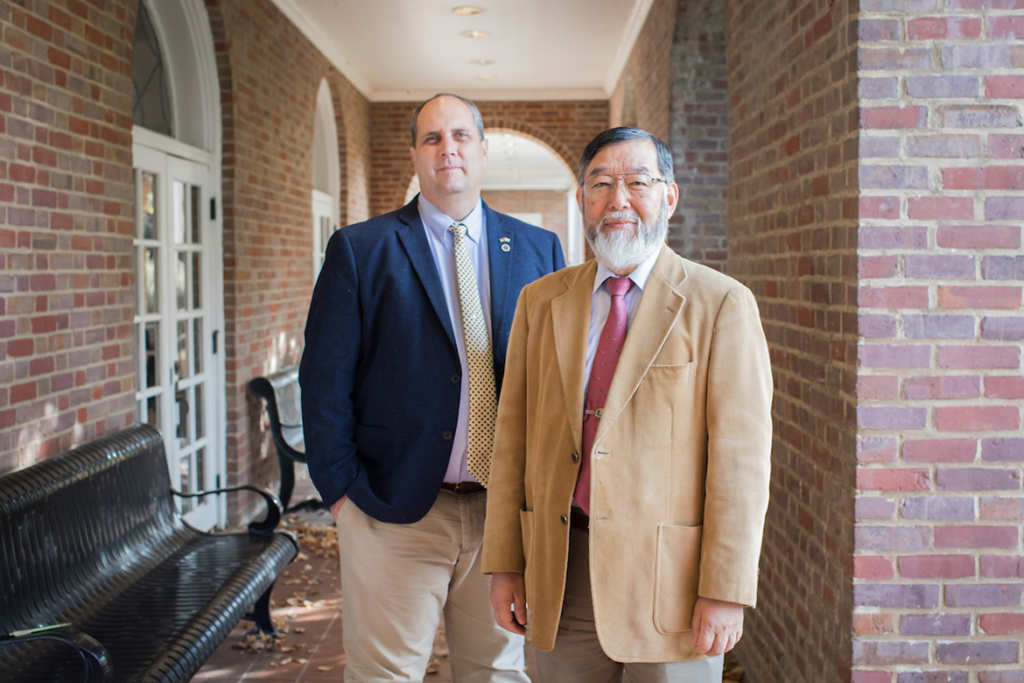

CLARKSVILLE, Tenn. – (CLARKSVILLENOW) Earlier this year, Yoshio Koyama, a retired businessman from Japan, set up his new office in Austin Peay State University’s Harned Hall.
During the semester, he’s taught a few language and culture classes, but Koyama isn’t a college professor. He is a liaison provided to the University by The Japan Foundation, and for the next two years, he will work at forging relationships between Austin Peay and the Japanese businesses currently operating in Tennessee and Kentucky.
According to the Tennessee Department of Economic and Community Development, Japan is Tennessee’s largest foreign investor, with 184 Japanese companies employing nearly 50,000 people in the state. The Asian nation has invested more than $17 billion in Tennessee, and several high-profile companies, such as Nissan North America Inc. and Bridgestone Americas Tire Operation, have opened corporate headquarters in the state.
Through his relationship with the Consulate-General of Japan in Nashville, Rands learned The Japan Foundation offers a highly competitive program that places six Japanese Outreach Initiative Coordinators in the United States each year. This year, those coordinators went to Michigan State University, Wake Forest University, the University of Texas at San Antonio, Marshall University, the Commonwealth of Kentucky and Austin Peay.
Last spring, Rands presented his proposal to The Japan Foundation, and that organization paired Austin Peay with Koyama, a coordinator with extensive business experience. Before joining the foundation, he worked for 25 years with JICA, the Japan International Cooperation Agency, traveling across the world on different business assignments. Koyama now lives on campus, and he has spent the last few weeks helping Rands develop a database on all the Japanese-owned businesses in Tennessee and Kentucky. They’ve also met with a few executives to find out their needs.
During those initial talks, Koyama and Rands discovered that many of these companies are unfamiliar with certain state initiatives, such as Tennessee Reconnect. That grant program, which covers tuition and mandatory fees in associate degree programs for adult learners without college degrees, could help these companies retain a highly educated workforce.
The University is still in the early stages of this project, but Rands is optimistic about its potential. With Austin Peay’s help, these companies, which have higher turnover rates in America as opposed to Japan, would have a resource for stabilizing their workforces. The partnership also could help the state in its efforts to have 55 percent of Tennesseans earn a college degree or certificate, while assisting the University in its strategic plan goal of enrolling 15,000 students by the year 2025.