


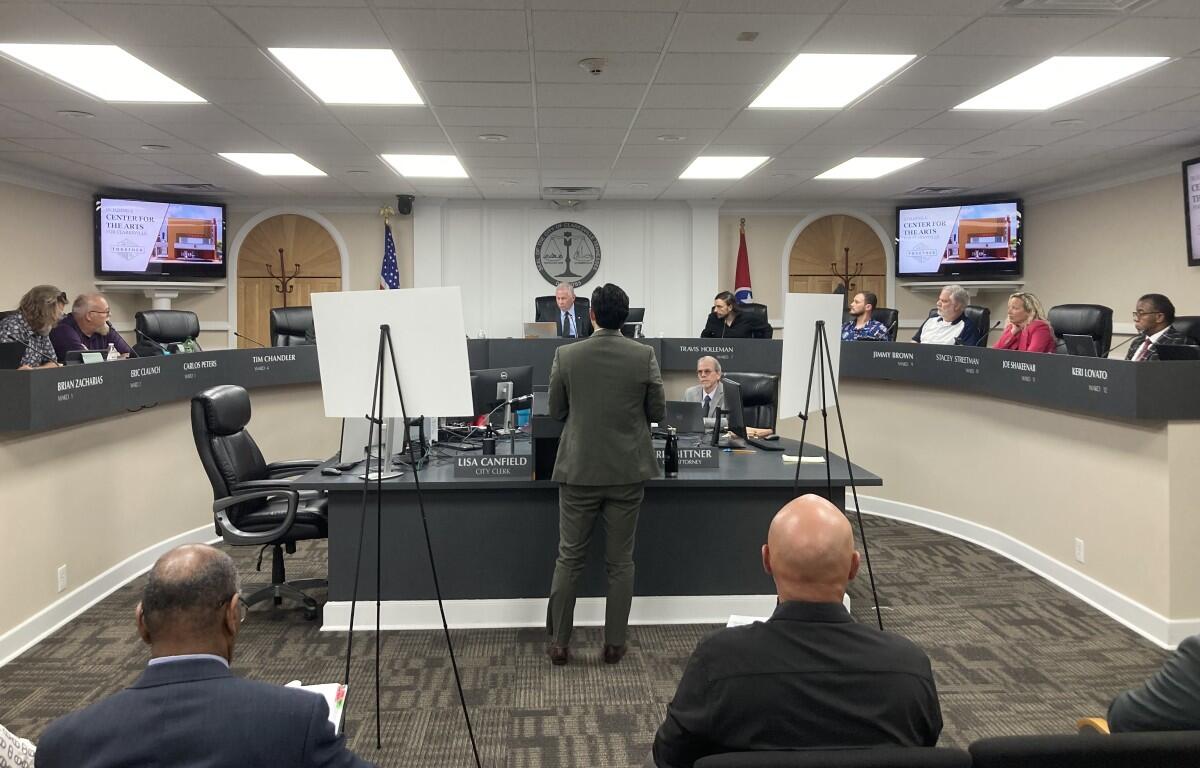

CLARKSVILLE, TN (CLARKSVILLE NOW) – ACT Authority Executive Director Cameron O’Hanlon addressed the City Council Thursday night about a proposed interlocal agreement for the city to back their loan to pay for construction of the Performing Arts Center.
After O’Hanlon’s presentation, several council members asked questions about the interlocal agreement and what it entails. If the interlocal agreement is not approved next week, the Performing Arts Center project would not move forward, and the dilapidated Roxy building would revert back under the City of Clarksville’s ownership with no future plans for use.


Under the agreement, the ACT Authority would need the City of Clarksville to “backstop” the construction loan, with the ACT Authority paying all debt service and construction costs.
Center for the arts: ‘This stage will be home to all art from every level’
O’Hanlon said that in his application to become executive director, he wrote to the board of directors that it is one of his core beliefs that institutions like the ACT Authority are a key galvanizing force in communities.
“Through art, we see each other more clearly, our capacity for empathy and grace strengthens, our impression of our own identities improves,” O’Hanlon said. “Our institutions must rise to meet this mandate, and leaders of those institutions must be the first to do so. And so, one year and three months after my first interview … I stand before you to take that charge and put my words into action.”
Performing Arts Center to celebrate Clarksville’s history, future
O’Hanlon said the designs of the new center will honor the history of 100 Franklin St. by refurbishing the original marquee and recreating the yellow brick box, maintaining the facade of downtown Clarksville.
“But the history of the Roxy (Regional Theatre) doesn’t exist in the marquee or in the yellow bricks, it exists in the hearts and memories of hundreds and thousands of people who have passed through its doors, and it exists in their stories. Because a theater is a vessel for storytelling.”
O’Hanlon said the building layout of the Performing Arts Center has been altered, as they have removed the flexible, black box auditorium from its design, saving around $12-13 million.
| PREVIOUSLY: Performing Arts Center plan updated to demolish 80-year-old Roxy building, re-create ‘yellow box’ front
Performing Arts Center capital campaign
“Our mission-oriented goals and financial goals are not diametrically opposed but deeply intertwined. That’s why good missions make for good businesses, and good businesses make for good missions,” he said. “We are embarking on a capital (fundraising) campaign to support this project.”
O’Hanlon said he was told recently that the City of Clarksville cannot support the debt associated with constructing the Performing Arts Center on their own. He said that is true, which is why the fundraising campaign structure to support this project is so important.
He said the city alone would not have the governance, nor capacity to operate a fundraising campaign of this size either. “And the ACT Authority alone does not have the history or the backing to support the debt on its own.” O’Hanlon said if the project is to succeed, it’s going to take both the city’s backstop and the community’s philanthropy.
$40 million campaign goal, 30 naming opportunities
O’Hanlon said through the capital campaign, the goal is to raise $40 million, and there will be 30 naming opportunities throughout the venue.
“And we have the framework to cast a wide net of support and include philanthropists of all kinds,” he said. “94% of the projected participants in this campaign will contribute less than $100,000, and only 2% will contribute over $1 million. With that being said, over 80% of the funds raised will come from those large gifts, while 6% will come from small donations.”


O’Hanlon said the campaign structure not only gives them the foundation for support and strong likelihood of success, but it also succeeds in engaging as many members of the community as possible.
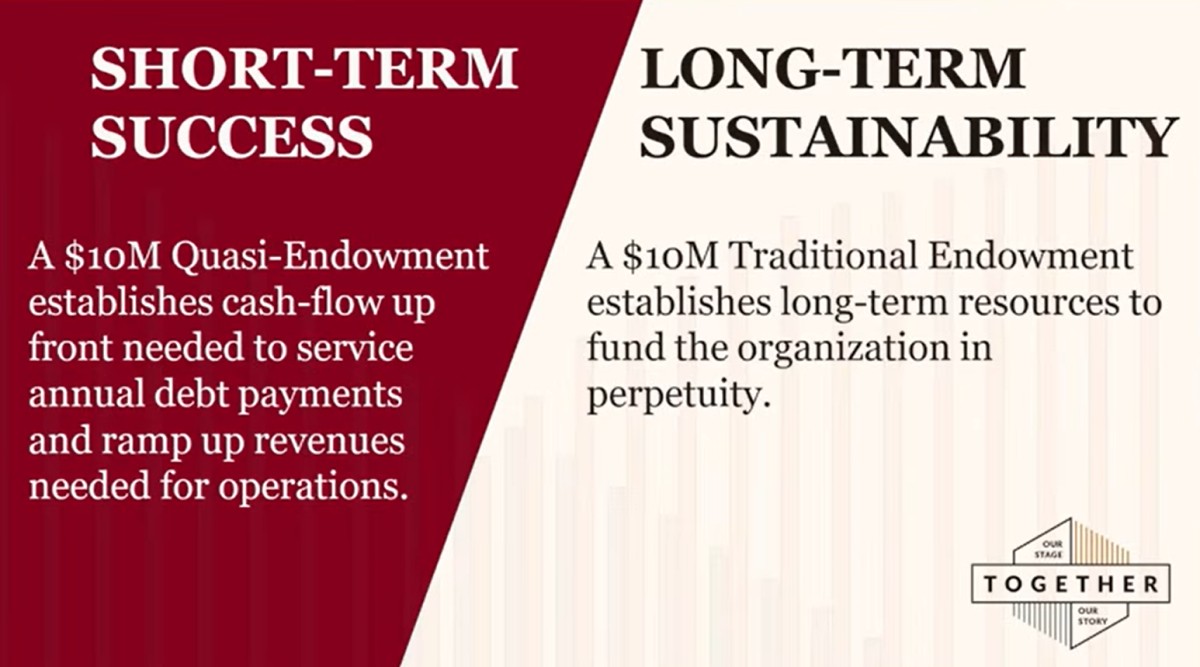
Campaign money will be managed in three ways, said O’Hanlon. Half of the money raised will go directly toward constructions costs, which will lower the amount of debt needed to be serviced. An additional 25% will go towards a traditional endowment, then another 25% will go towards a quasi-endowment.
“One structure to provide immediate support for the venue, and one structure to provide long-term sustainability,” he said.
O’Hanlon: Aggressive goals, conversative planning
“As aggressive as we are being with our goal setting … we’re equally, if not more conservative in our planning,” O’Hanlon said. “While we aim to raise $40 million through our campaign, the financial projections that show zero additional support from the city, plans for only $10 million being raised by opening night, and $10 million raised through the first five years.”
O’Hanlon said they projected all annual debt service payments at their maximum to play into their conversative approach, as well as projecting ticket revenue $1 million less per year than the original feasibility study conducted. “And annual fundraising less than 50% of our operating budget, much less than a traditional nonprofit,” he said.
In their projections, the ACT Authority also excluded the additional hotel-motel tax earnings from four projected new hotels in Clarksville. “That projection contributed around $250,000 per year from the hotel-motel tax projections,” he said.
“Even with this conversative approach, projections show zero additional city funds will be needed to service the debt on this project. Because of this approach, it’s unlikely that we should find ourselves short of those projections. But even if we do, the (interlocal) agreement before you today requires the ACT Authority to repay any additional funds provided by the city at the earliest opportunity.”
O’Hanlon said worst case scenario shows the most likely case where the city would have to provide additional funding for the Performing Arts Center would be somewhere between $500,000-$700,000 a year for two to three years. “Then they’d recoup those funds a few years later.”
Councilwoman Wanda Smith said the worst-case scenario concerned her due to how condensed the city’s budget has become, which is the reason she will be voting no, even though she supports the project’s mission.
Questions about construction timeline, hotel-motel tax savings
Councilman Joe Shakeenab asked about the projected construction timeline and the cost associated with it.
O’Hanlon said the projected start of construction depends on the adoption of the interlocal agreement. “If this body adopts the interlocal agreement, I believe the next step is the Comptroller’s Office. We could break ground in two months,” he said. “The team is ready to go; the contractors are queued up.”
O’Hanlon said between the demolition of the existing Roxy site and construction of the Performing Arts Center, it would cost approximately the ACT Authority $65 million for the project today.
| NEWS TIPS: Do you have a local news tip? Email news@clarksvillenow.com or call us at 931-648-7720.
Shakeenab also asked how much money has already been accumulated from hotel-motel taxes.
The ACT Authority executive director said they bring in around $1.7 million annually right now from hotel-motel taxes, and by the time the venue opens, the organization should have saved somewhere in the ballpark of $2.2-$2.3 million in cash reserves.
“That’s an important point to make because the ACT Authority is not a department within the city, so we maintain our own cash flow, we maintain our own accounts. On any given fiscal year where we have a deficit … first we would apply our cash reserves to that,” O’Hanlon said.
Council member questions about interlocal agreement
Councilwoman Keri Lovato asked about the annual projected cost of the debt associated with the project.
O’Hanlon said as currently projected, if they don’t apply any of the fundraising to the construction costs to lower the debt service, the maximum price the ACT Authority would pay would be $4.7 million per year starting in 2030.
Lovato also asked about average ticket pricing. O’Hanlon said average ticket prices are sitting at $50, and the lowest entry level ticket price into the building is at $35.
“My concern is, is there enough cushion for you all to pay your operational costs and the debt services starting in 2030,” Lovato asked.
O’Hanlon said the concern is valid, but he feels confident about the projections made. “Those projections assume we only raise $10 million of the total $40 million by 2028 when we open. Then, we would raise an additional $10 million through the next five years, either through pledges on those initial gifts, or through fundraising.”
Lovato said while she is also in favor of the project’s mission, she’s a no-vote currently, because she believes there is not enough cushion for the ACT Authority to prevent the obligation from falling under the City of Clarksville.
Councilman Travis Holleman said next week he believes he can make a strong case that the “numbers don’t line up” when comparing the risk-to-reward ratio for the project.
| MORE: Seeds we sow: The time is now to build new Performing Arts Center | COMMENTARY
Details on existing fundraising efforts
Councilwoman Stacey Streetman asked if O’Hanlon could share any details about fundraising efforts for the project.
O’Hanlon said based on conversations he’s had with members of the community; they’ve laid the groundwork for those “major asks.”
“I am confident those will come through,” he said. “I imagine they are waiting for this agreement. It’s hard to fundraise for a building that you do not yet own. … And so, we have queued all of this up. As you do with these types of campaigns, you start at that 2% of those largest gifts; we’ve started at the multi-million-dollar gifts.”
O’Hanlon estimated if every gift did comes through with the philanthropists they’ve already spoken to, they’d be halfway through their fundraising goal at $20 million.
Mayor Joe Pitts said he’s confident in the fundraising effort based on the conversation’s he’s had with people and businesses willing to donate. “Nobody said no and threw us out of their office, and we’ve asked them for some big numbers.,” Pitts said.
When interlocal agreement needs to be approved
Councilman Brian Zacharias asked, for the interlocal agreement to move forward with its current timeline, as well as pricing, when would it need to be approved?
O’Hanlon said the agreement would need to be approved this month, or during the City Council’s regular session meeting next month. “After that, we begin to lose subcontractors, our price guarantees … and prices and interest rates will continue to go up.”
The City Council will meet Thursday, Oct. 1, to vote on the interlocal agreement.
| ADD US ON GOOGLE NEWS: Click here to see more local news from Clarksville Now