


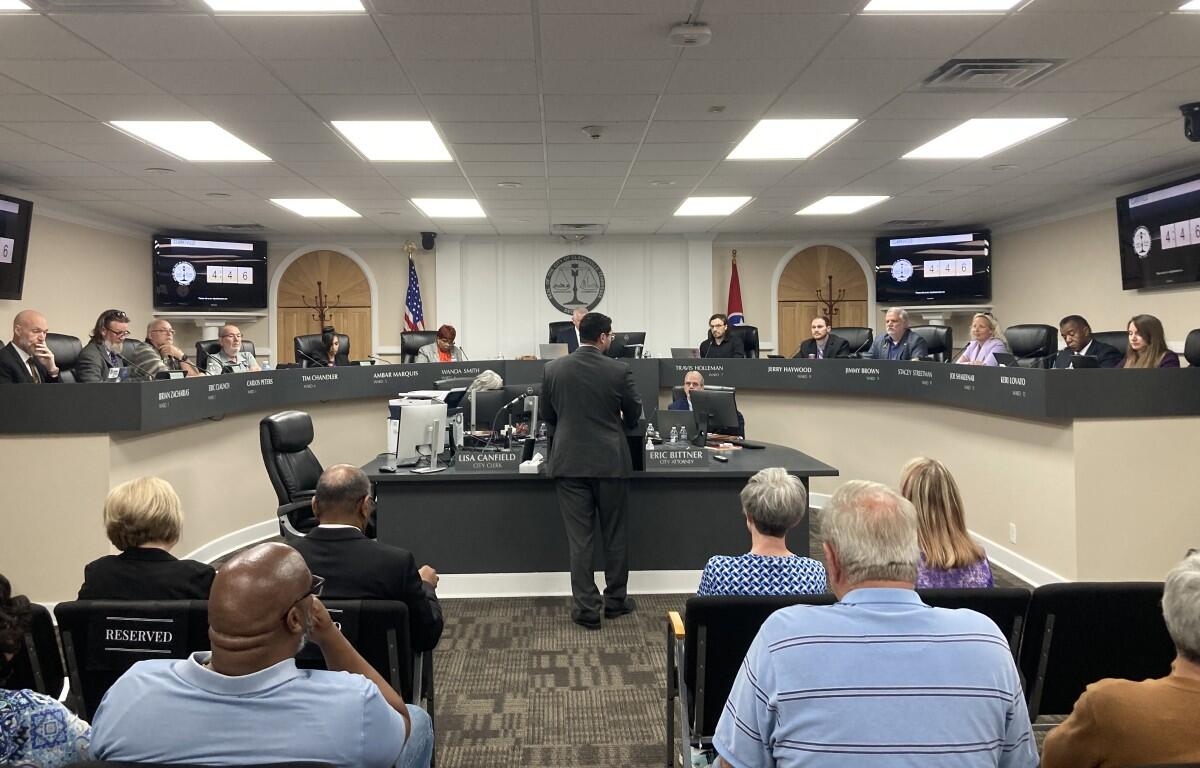

CLARKSVILLE, TN (CLARKSVILLE NOW) – The Clarksville City Council held a special work session Tuesday night to hear from several department heads on why a 31-cent property tax increase should be implemented for the next fiscal year and what’s at stake.
The City of Clarksville also explained how an average homeowner would be impacted by the proposed 31-cent tax increase, and how recent city budgets were not “structurally sound.”
How city’s FY budget process unfolds annually
City of Clarksville CFO Christen Wilcox and Deputy CFO Regina Hampton gave an overview of the city’s budget process, and how tax rates and revenues built the city’s FY 2026-27 budget.
Hampton said the process begins to unfold in February, and the first step is to speak with the department heads to understand their needs for the remainder of the year, while also planning for the next fiscal year.
“Between March and May, Finance works diligently with the mayor and all department heads to prepare a structurally balanced budget. This is to continue to provide the departments’ crucial services to our citizens,” she said. “The budget is then brought to this body for approval in June; state law requires that council approve this budget, and it must be submitted to the comptroller within 15 days of adoption.”
‘We have lost sight that the budget is structurally sound’
She went on to describe a structurally balanced budget, which means a budget that supports financial sustainability for multiple years in the future. “Additionally, recurring revenues must equal or exceed recurring expenditures.”
Hampton said, “As the city is focusing on a maintaining a budget with no property tax (rate) increase, we have lost sight that the budget is structurally sound.
“For example, in effort to balance the budget for the last two fiscal years, we have not funded the self-insurance fund. This has not presented an issue, as we have not had any significant settlements. … However, this is not sustainable.”
Hampton said the proposed tax rate of $1.23 per $100 of assessed value would bring the city toward a structurally sound budget, and she laid out how the increase would be distributed.
- Public safety (Police and Fire Departments, Building and Codes) – $0.64.
- Debt service – $0.14.
- Street Department – $0.13.
- General Services (city admin.) – $0.12.
- Parks and Recreation – $0.09.
- Transit – $0.04.
- Appropriations to outside agencies – $0.03.
- Support services (building and facilities, maintenance, city garage) – $0.03.
- Neighborhood and Community Services – $0.01.
What if tax rate remains at $0.92?
Hampton posed the question: What if the tax rate remained at $0.92 for the next fiscal year? She said the city would have to remove $21 million from operating expenditures.
Hampton said they created a list of higher dollar budget items that would make up a little more than half of the cost of what would be cut if the tax rate remain unchanged. That list included a reduction of $7 million from the budget for all new vehicles requested, as well as asking departments like Clarksville Fire Rescue, Clarksville Police to reduce their budget by $1 million to $1.5 million.
How average homeowner would be affected
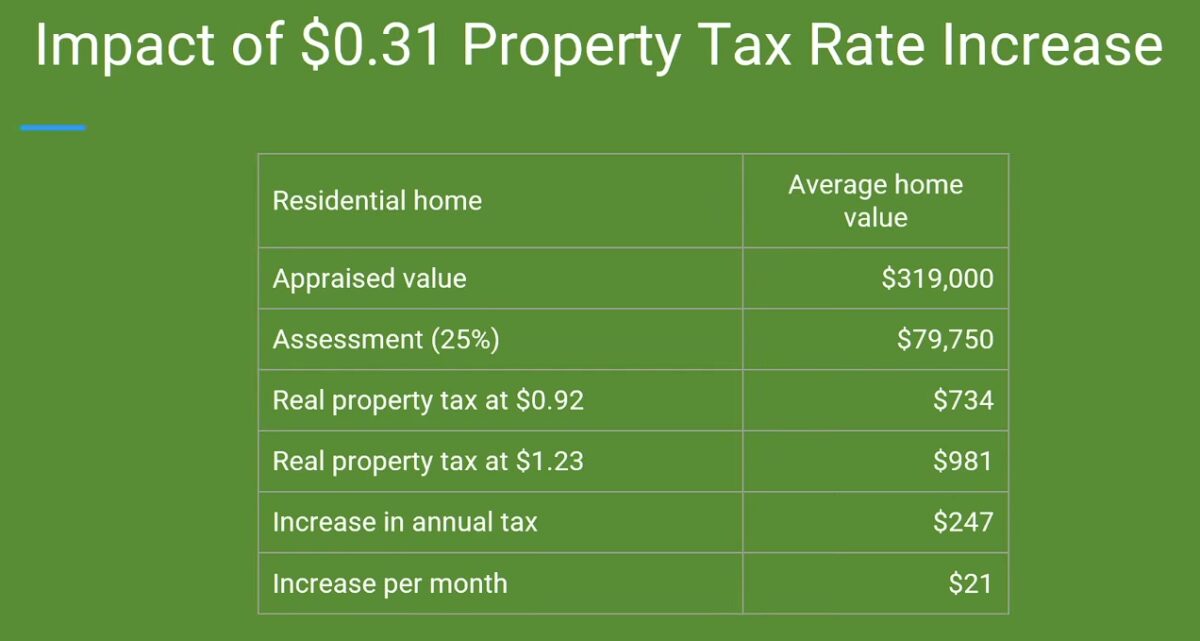
Hampton presented a graphic showing how the property tax increase would impact your average homeowner.
“As you can see in this example, the average homeowner with an appraised value of $319,000 will see an increase of $21 per month if the tax rate of $1.23 is adopted,” she said.
Approved $42.5 million bond requies tax rate of $1.23
Hampton also said the $42.5 million bond anticipation note that the City Council approved earlier this month must be supported by the $1.23 tax rate.
The bond anticipation note is projected to fund city projects such as the new Building and Codes facility, renovations to Mason Rudolph Golf Course and Swan Lake Golf Course and Phase 2 of Spring Creek Parkway.
The bond issuance also is projected to fund sidewalks and crosswalks for Highway 48/13, Phase 1 of Memorial Drive Extension, as well as continued roadwork on Tylertown Road and Oakland Road.
Tax relief and tax freeze programs offered
“We know this is very impactful to our most financially vulnerable citizens, so we also want to take this time to highlight programs that both the city and the county have in place to assist and offering a reduced impact of these costs.”
Hampton highlighted two programs, the tax relief program, which is a voucher-based reimbursement program for low-income seniors, disabled individuals and disabled veterans. More than 5,500 households were on tax relief for the 2025 tax year.
The second was the tax freeze program. More than 1,000 households were on the tax freeze program in tax year 2025.
She also went over FY 2026-27 revenue stream types.


The department heads then addressed the City Council and fielded questions.
| ADD US ON GOOGLE NEWS: Click here to see more local news from Clarksville Now