


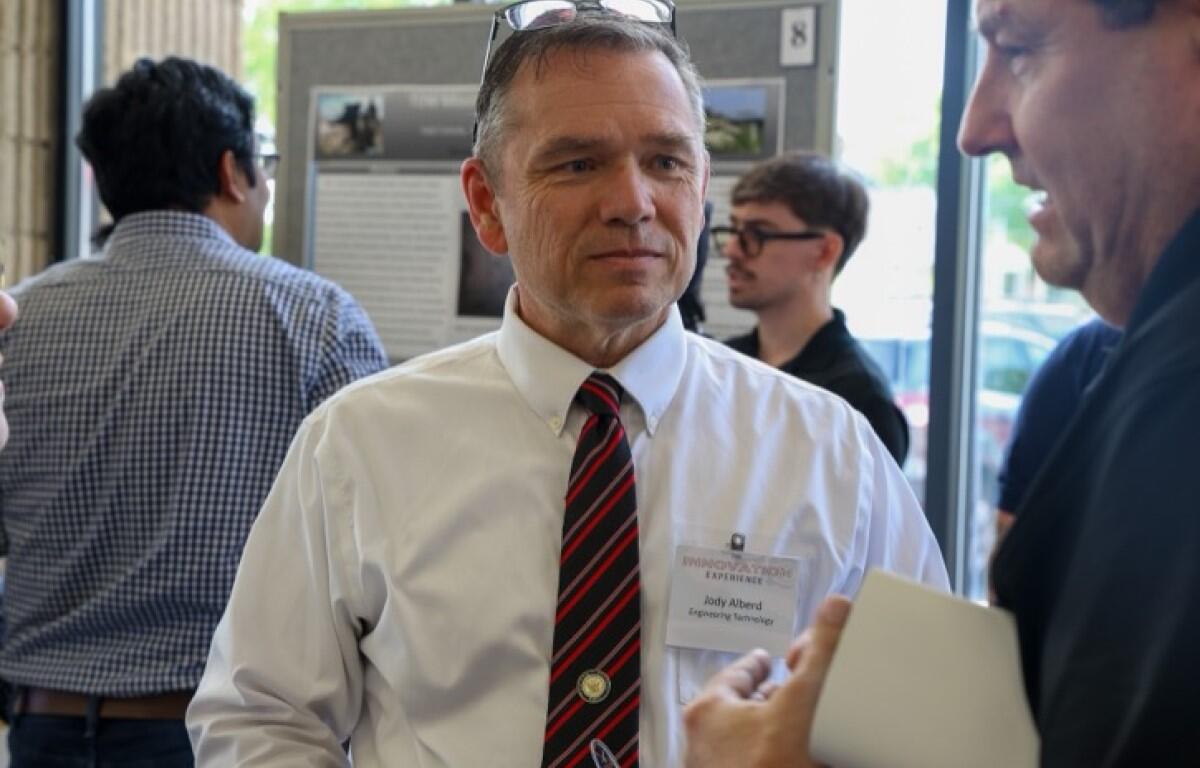

CLARKSVILLE, TN – Jody Alberd knows the challenge of transitioning from military service to engineering studies. After 20 years in the Navy, he found himself at Austin Peay State University navigating the same academic halls he now teaches in as an assistant professor in the Department of Engineering Technology.
That personal experience has now evolved into groundbreaking research. Alberd recently received his first National Science Foundation (NSF) grant as principal investigator—a Research Initiation in Engineering Formation (RIEF) award to study how student veterans develop their engineering identity throughout their senior capstone design projects.
“Veterans come in with a very strong and very powerful military identity that’s already well established,” Alberd said. “So we want to look at, how does that transition into an engineering identity formation?”
The two-year study will focus on student veterans in engineering physics and engineering technology programs, examining a critical juncture in their academic careers when theoretical knowledge meets practical application.
From Personal Experience to Research Questions
Alberd’s research path began with his journey from naval service member to engineering educator. After retiring from the Navy, he completed his engineering technology degree at Austin Peay, experiencing firsthand the identity challenges he now seeks to understand academically.
“One of the things I think that student veterans struggle with is understanding that that military identity doesn’t have to be completely exclusive to the engineering identity,” he said. “You can integrate those together, and they just don’t necessarily know how to do it before they get into these projects.”
The research addresses what Alberd describes as a unique form of imposter syndrome for veterans.
“You come in and you see yourself as a soldier or a sailor or a Marine, and then now you have to see yourself as an engineer,” he said. “That’s a challenge for everybody, but more so when you have already established a strong identity through your military career.”
How the Study Works
The study will follow student veterans throughout their senior capstones, interviewing each participant at the beginning, middle, and end to track their evolving sense of identity.
Alberd said the research seeks to answer three questions:
- How do student veterans experience and describe their engineering identity development during the capstone design projects?
- What aspects of that capstone environment—whether it be teamwork, mentorship, or the technical challenges—support or even possibly inhibit their identity formation?
- How do student veterans reconcile their prior military identity with their new emerging identity as engineers?
Nothing about the capstone experience will change for participating students. The goal is to observe the current process and understand how identity takes shape within Austin Peay’s engineering programs.
Although this is Alberd’s first NSF grant as principal investigator, he has assembled an experienced support team. His co-principal investigator is Dr. Marie Paretti from Virginia Polytechnic Institute and State University, who has an extensive background in engineering education research and capstone project development.
Paretti will serve as Alberd’s mentor for the project, offering strategic guidance and support in its design, implementation, and evaluation.