


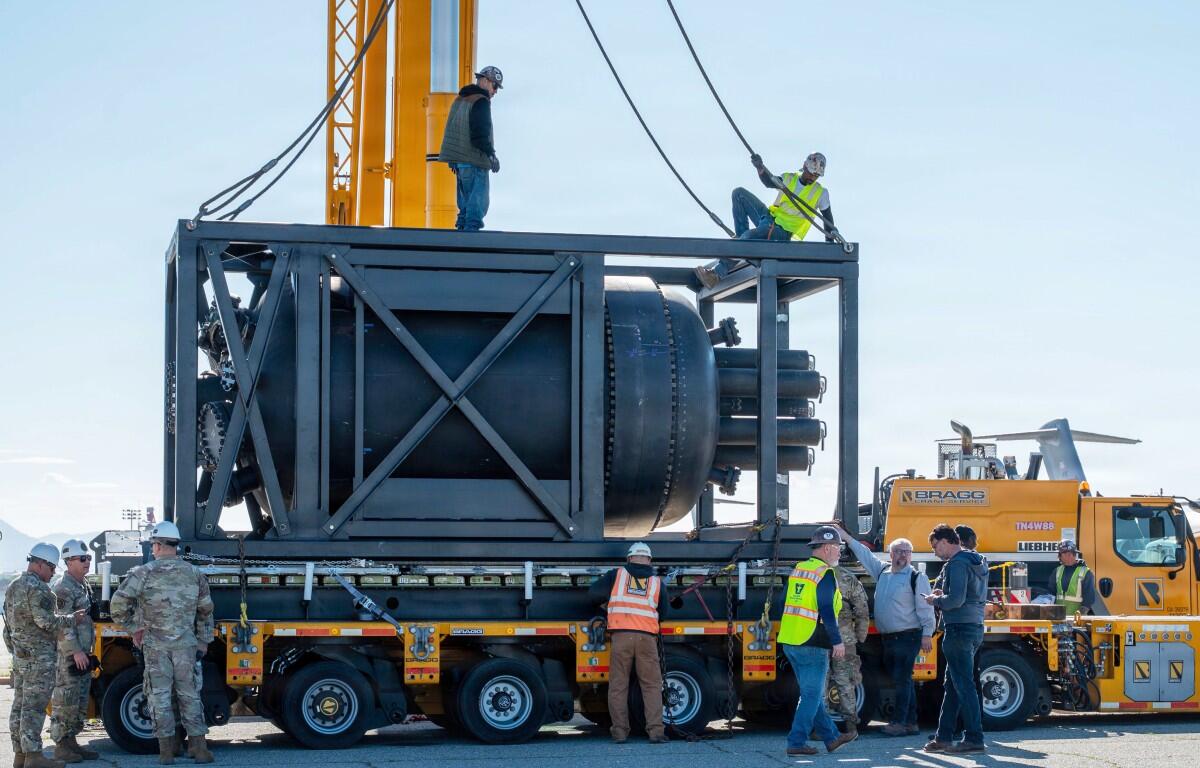

FORT CAMPBELL, KY (CLARKSVILLE NOW) – Fort Campbell has been selected as one of five military installations to host an advanced, next-generation microreactor power plant under the Army’s Janus Program.
The $2.2 billion project is in close partnership with the Defense Innovation Unit (DIU), with the goal of securing uninterrupted, resilient power for critical defense missions, according to a Fort Campbell news release.
Fort Campbell will be working with BWX Technologies Inc. (BWXT) to deploy a smaller, single 20-megawatt version of its BWXT Advanced Nuclear Reactor (BANR) technology. Detailed site-characterization, licensing, and design phases will begin immediately, with groundbreaking projected for late 2028 and reactor operations expected to commence in the early 2030s.
The exact location of the site has not been announced.
Footprint of microreactor, transparency
The microreactor will occupy a footprint of less than 5 acres, entirely on post. Operating “behind the meter,” the facility will be dedicated exclusively to powering mission-essential operations on Fort Campbell. This allows the installation’s national security assets to function completely independently from the commercial power grid during severe weather events, cyber disruptions, or regional blackouts, the release said.
| GET YOUR LOCAL MORNING NEWS: Sign up for our free daily email newsletter.
“We are excited that Fort Campbell was selected to host an advanced, next-generation microreactor powerplant under the Janus Program,” said Maj. Gen. David W. Gardner, commanding general of the 101st Airborne Division and Fort Campbell. “This initiative delivers resilient, 24/7 power directly to our installation, ensuring critical operations remain secure and uninterrupted as we respond to the nation’s needs.”
For comparison, here is the power generation of this and some nearby power plants:
- Fort Campbell microreactor: 20 megawatts
- Cheatham hydroelectric dam: 36 megawatts
- Cumberland gas plant: 1,450 megawatts
- Cumberland fossil plant: 2,500 megawatts
Fort Campbell says they are committed to maintaining transparency with municipal, county and state leaders across the Kentucky-Tennessee border. Local communities will continue to have opportunities to engage, ask questions, and provide feedback as environmental assessments under the National Environmental Policy Act (NEPA) and independent military regulatory processes proceed.
More details about microreactor
In November of 2025, it was announced that Fort Campbell has been selected as one of the nine Army installations in the country being considered as a potential location for a microreactor power plant.
The Army maximized the number of potential sites based on technical feasibility, site suitability and available resources. The five selected vendors and installations are:
- Antares Nuclear, Inc. – Fort Bragg, North Carolina
- BWXT Advanced Technologies, LLC – Fort Campbell
- General Atomics Electromagnetic Systems – Fort Hood, Texas
- Radiant Industries, Inc. – Fort Benning, Georgia
- Westinghouse Government Services – Fort Drum, New York
The selection is the culmination of a year-long, rigorous technical evaluation analyzing site suitability and installation mission requirements, according to the news release. Under the program, the Army and DIU are negotiating milestone-based Other Transactions Authority (OTA) agreements utilizing a competitive Commercial Solutions Opening (CSO) process.
“The Janus Program is about transitioning from designs and experiments to reliable commercial hardware which secures our energy independence,” said Dr. Jeff Waksman, principal deputy assistant secretary of the Army for Installations, Energy and Environment.
The advanced nuclear technology utilizes TRi-structural ISOtropic (TRISO) fuel, widely recognized as one of the most robust and meltdown-resistant nuclear fuels on Earth. The reactor is designed with inherent safety features, meaning it relies on the laws of physics rather than operator action or external power to automatically cool and shut down safely in the event of an emergency.
This investment model brings together approximately $2.2 billion across fiscal years 2027-2031 along with significant capital investment from each vendor. The prototype reactors will be contractor-owned and operated.
Chris Smith contributed to this report.
| MILITARY NEWS: More articles about Fort Campbell and the 101st Airborne Division